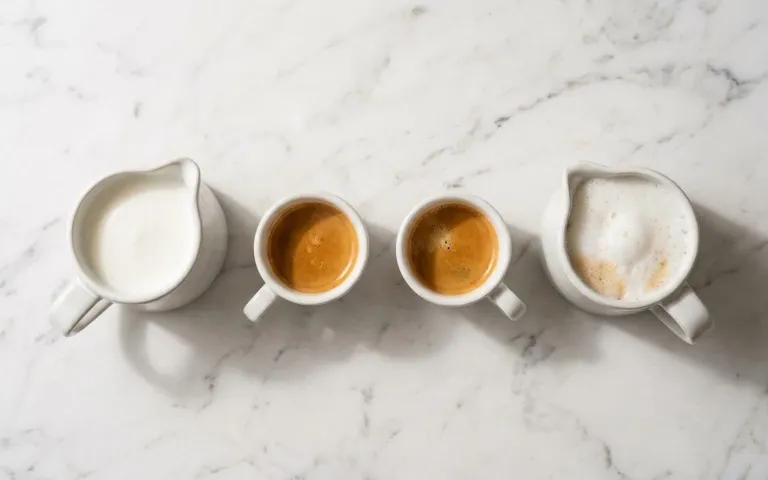
A flat white and a latte usually start from the same double espresso. The flat white is the smaller drink, around 160 to 180ml with roughly a 5mm layer of microfoam, while a latte is 230ml or more with a thicker layer of steamed milk and a deeper foam cap. That extra milk is why a flat white tastes stronger, even when the caffeine in both cups is identical.
The flat white vs latte question keeps coming up in UK cafés for a reason: both drinks are poured freehand, cup sizes vary from chain to chain, and the flat white you paid a premium for sometimes arrives looking exactly like a latte. Untangling it means checking three variables for yourself, milk volume, foam depth and cup size, not vague talk of 'stronger' or 'milkier'.
I have compared these two drinks against Anette Moldvaer's reference spec for a flat white, as summarised by Wikipedia, against Pret A Manger's own published nutrition data for both drinks, and against more than 300 reader posts pulled from Mumsnet, PistonHeads and a long-running flat white comment thread. I have added what I taught baristas about milk drinks as an SCA-certified barista who started out training staff at UCC Coffee.
If you want the recipe rather than the argument, see the dedicated guide on how to make a flat white, which carries the method, the ratios and the milk-texturing technique this page does not.
“Everything is poured freehand, so a flat white, cortado, cappuccino, and latte all end up being very similar. Only the size is the determining factor.”
“...a flst white [sic] very little froth a couple mm, a latee has about 8-15mm and a cappuccino has about 2cm of froth”
phillip, peterjthomson.com
And a reader called Chris, in the same comment thread, spoke for a lot of searchers on this exact keyword:
“I read the article and still have absolutely no idea what the difference is between a flat white and latte.”
Chris, peterjthomson.com
That confusion is fair, and it is probably why you are reading this. Every top-ranking explainer defines both drinks.
Almost none of them prints a real number for the calorie gap, covers where a cortado fits, or admits that the caffeine is usually the same. This page does all three, so you can stop guessing at the counter.
Flat White vs Latte: The Difference at a Glance
Both drinks you are choosing between are built on the same shot. What changes is how much milk goes on top of it and how that milk is textured, and that is exactly what you taste first.
Feature
Flat White
Latte
Typical volume
160-180ml
230ml or more
Espresso
Double espresso, about 50ml
Double espresso, about 50ml
Steamed milk
About 130ml
Fills most of a larger cup or glass
Foam
Thin microfoam, about 5mm
Thin foam cap, or none at all
Taste
Stronger coffee flavour through less milk
Softer, milkier coffee flavour
Best drunk
Short, while it is still hot
Over a longer sitting
A flat white is not a small latte with a different name on your cup. It is the same coffee, carrying less milk, in a smaller vessel, finished with a thinner layer of foam. Every real difference you can taste between the two drinks comes back to one of those three variables.
What Is a Flat White?
If you order a flat white, you should get a double espresso, around 50ml, topped with roughly 130ml of steamed milk finished in a thin, about 5mm, layer of microfoam, the reference spec that Anette Moldvaer sets out in The Coffee Book, as summarised by Wikipedia. Where it was invented is genuinely disputed.
Sydney's Moors Espresso Bar added the drink to its permanent menu in 1985, and a separate Sydney café, Miller's Treat, referred to a 'flat white coffee' as early as May 1983. New Zealand has its own claim, with a Wellington bar reportedly serving a 'failed cappuccino' in 1989 that became the drink, and a separate account crediting an Auckland café in the mid-1980s. Pick whichever story you find more convincing, since neither side has ever settled it.
The flat white reached the UK from Australia and New Zealand, arriving in British cafés by around 2005 and in UK Starbucks branches by 2010. It has grown fast since, and if you care about the bean under the milk, you are in the right place. Best coffee beans for latte covers bean choice for milkier drinks, but a flat white rewards a well-roasted, high-quality bean precisely because there is less milk in your cup to hide behind it, which is exactly what makes coffee speciality grade in the first place.
What Is a Latte?
A caffè latte, Italian for 'milk coffee', pairs a double espresso with more steamed milk than a flat white and finishes in a thin foam cap rather than a defined layer of microfoam. Wikipedia's entry on the drink puts a standard serving at 230ml or more, roughly double the size of a traditional Italian cappuccino's 140ml cup, so if that is what lands in front of you, it is meant to be that big.
The extra milk is the entire point of a latte. It softens the espresso rather than concentrating it, which is why the drink suits a longer, slower cup rather than a quick one. If you want to build one at home, see the dedicated guide to how to froth milk, since a latte's foam cap needs a different technique from a flat white's microfoam.
Is a Flat White Stronger Than a Latte?
Yes in taste, not necessarily in caffeine. Most UK cafés pull the same double espresso for a flat white and a latte, whichever one you order.
The difference is what happens to that shot afterwards: a flat white gets roughly 130ml of milk poured over it, a latte gets a great deal more. Less milk means less dilution, so the coffee comes through more clearly on your palate even though the espresso underneath is unchanged.
This is the point most explainer pages blur, and it matters if you are ordering for the caffeine, not just the taste. If you switch from a latte to a flat white expecting more caffeine, you will usually be disappointed, because both cups typically contain the same shot. What you are buying is a stronger flavour, not a bigger dose.
The European Food Safety Authority treats intakes up to 400mg of caffeine a day as safe for healthy adults, worth knowing before you stack multiple 'stronger' coffees on the strength of taste alone, and it puts the safe daily limit for pregnant women at 200mg, a figure the EFSA and the NHS both hold to. When I trained baristas early in my career, this was the single most common misunderstanding at the counter, staff and customers alike treating 'stronger' and 'more caffeine' as the same claim when they usually are not.
Why the Flat White You Buy Can Taste Like a Latte
Part of the confusion is that there is no official standard you can check a cup against. The Speciality Coffee Association's own coffee standards page carries no definition for a flat white, a latte or a cappuccino, and the explainers that do define them disagree with each other. One well-known guide gives both drinks an identical one-third espresso to two-thirds milk ratio.
Another insists a flat white is made exclusively with a double ristretto shot. A third accepts a single-shot flat white as correct in New Zealand and Australia. None of that is settled science, whatever the certainty of the page you happen to be reading.
The bigger cause, though, is size creep, and it is the one you are most likely to hit yourself. A flat white only stays a flat white if the espresso scales with the cup, and in practice it often does not.
Order a large flat white and most cafés simply pour more milk over the same double shot, which quietly turns your drink into a latte in every respect except the name on the cup. That is the exact grievance running through the Mumsnet thread above: readers paying a flat white price for what arrives as a latte-sized cup.
I spent five years on the road for Sanremo UK, tracking down the best flat white in every town from Inverness to Exeter, and the inconsistency was real even a decade ago, the same inconsistency you can still run into today. Some cafés hold their flat white to a strict small cup and a single measured pour.
Others treat the name as a menu label rather than a recipe, and pour whatever their usual jug happens to hold. There is no shortcut to knowing which you are getting beyond asking the barista what size the cup is before they pour.
Flat White vs Latte Calories: Which Is Healthier?
Not by much either way, whichever one you choose. Pret A Manger's own published figures put its 8oz flat white at 98 kcal against 136 kcal for its 12oz latte, a 38 kcal gap that comes almost entirely from the extra milk in the bigger cup.
Flat White (8oz)
Latte (12oz)
Calories
98 kcal
136 kcal
Fat
3.4g (saturates 2g)
4.6g (saturates 2.8g)
Carbohydrates
10g (sugars 10g)
14g (sugars 14g)
Protein
6.8g
9.5g
Salt
0.15g
0.15g
Per 100g
37 kcal
40 kcal
Look at the per-100g figures rather than the per-serving ones on your own cup and the two drinks are almost identical, 37 kcal against 40 kcal. The gap in the headline numbers is a cup-size effect, not a formulation difference.
Milk choice moves the total more than the drink name does: swapping to an alternative milk or adding syrup changes the calorie count far more than choosing a flat white over a latte ever will. Neither drink earns the label 'the healthy choice' on this evidence, and I would not sell it to you as one.
Is the Flat White Australian or From New Zealand?
Both countries claim it, and neither has conceded. The full origin timeline sits above in 'What Is a Flat White?': Sydney's early 1980s cafés against Wellington's 'failed cappuccino' from 1989. Pick whichever version you find more convincing, since no menu label settles it for you.
Whichever side of the Tasman Sea it began on, the flat white has become one of the UK's most ordered coffees, and there is a fair chance you have ordered one yourself this week. The Economist reported in 2024 that one in three UK consumers chose a flat white, and that Pret alone sold eight million of them in the previous year, close behind the nine million cappuccinos it sold in the same period.
Latte vs Cappuccino, and Where the Flat White Sits
A cappuccino is the most milk-forward of the three in structure, even though it is one of the smallest in volume, so if you order one expecting a bigger drink than a flat white, you will be surprised. In Italy, a cappuccino consists of around 25ml of espresso, with the rest of a cup, traditionally no more than 180ml, filled with equal parts steamed milk and thick foam.
That thick foam cap is what separates it from both a latte and a flat white. Wikipedia's entry on the drink notes that in Italy and across continental Europe, cappuccino is treated strictly as a breakfast drink, so order one after 11am there and you will get a look.
A latte sits at the opposite end from a cappuccino: more milk, a thinner or absent foam cap, and a far bigger cup, 230ml against a traditional cappuccino's 140ml. The flat white lands between the two on volume but closer to a cappuccino on intent: it is built to let the espresso lead, so if that is what you want, order the flat white rather than the cappuccino's thick foam.
Cortado vs Flat White
A cortado is smaller again than any of the three drinks above, so ask for one if even a flat white feels like too much milk for you. It combines espresso with roughly an equal amount of warm milk, steamed but deliberately not textured into foam, a Spanish preparation intended to soften the espresso's acidity rather than lengthen the drink. Wikipedia's cortado entry notes the exact ratio varies by region, but the principle, a small, roughly one-to-one pour with no foam layer, holds across most of them.
Set beside a flat white, the difference is milk volume and texture rather than strength. A flat white carries more milk and a defined microfoam layer; a cortado carries less milk with none of that foam structure at all. Mariposista's comment on the Mumsnet thread above captures the appeal well: a cortado suits you if you want the espresso itself, softened rather than diluted, in the smallest cup on the menu.
Which Should You Order?
Run the four drinks against the same criteria and the answer changes with what you want from the cup, not with which drink is objectively 'best'.
Criterion
Weight
Flat White
Latte
Cappuccino
Cortado
Coffee flavour intensity through milk
25%
High
Low
Medium
Highest
Milk volume you want
25%
Medium-low
High
Medium
Low
Texture: silky vs airy
20%
Silky microfoam
Soft, thin foam cap
Thick, airy foam
Little or none
Drink length, time to sip
15%
Short
Long
Short to medium
Shortest
Consistency across UK cafés
15%
Variable
Consistent
Variable
Often not on the menu
If you want to taste the coffee and drink it quickly, order a flat white, and choose a café that pulls a proper espresso shot rather than one that leans on volume of milk to disguise a weak one. If you want a longer, softer drink to sit with, order a latte.
If you want the ceremony of thick foam and do not mind drinking it before 11am on the Italian model, order a cappuccino. If you want the espresso itself with the smallest possible softening, ask for a cortado, though not every UK café will have one on the machine.
Training baristas at UCC Coffee taught me that most 'which one should I order' hesitation is, at heart, a milk-volume question in disguise, the same thing I now see covered in most decent barista lessons in the UK. Once you can name how much milk you want in the cup, the right drink usually names itself for you. The bean underneath still matters more than most menus suggest, especially on a flat white, where there is barely any milk left in your cup to carry a poor roast.
Flat White, Latte, Cappuccino and Cortado Compared
A quick reference for the four drinks side by side, drawn from the definitions above.
Drink
Typical Volume
Espresso
Milk
Foam
Origin
Flat White
160-180ml
Double espresso, about 50ml
About 130ml steamed milk
Thin microfoam, about 5mm
Australia or New Zealand, 1980s
Latte
230ml or more
Double espresso, about 50ml
More steamed milk
Thin foam cap, or none
Italy
Cappuccino
150-180ml
About 25ml espresso
Equal parts steamed milk
Equal parts thick foam
Italy
Cortado
Small, roughly equal parts
Espresso
Roughly equal warm milk
Little to none
Spain
If you are buying beans for milk drinks at home, these are three UK roasters whose espresso blends are described as working well with milk. This is optional guidance, and any fresh medium roast espresso will do the job.
Yes in taste, not necessarily in caffeine. Most cafés pull the same double espresso for both drinks, so a flat white simply carries less milk to dilute it. Order one for the coffee flavour, not for an automatic caffeine boost over a latte.
How unhealthy is a flat white?
Not much. Pret's own published data puts its 8oz flat white at 98 kcal and 3.4g of fat. A flavoured syrup or a larger cup will move those numbers far more than the choice between a flat white and any other milk coffee.
Is flat white an Australian thing?
Australia and New Zealand both claim it, and neither has settled it. Sydney's Moors Espresso Bar added the drink to its menu in 1985, while Wellington's Bar Bodega describes a 'failed cappuccino' from 1989. Treat it as a shared invention.
Is flat white a British thing?
No. The UK imported the flat white from Australia and New Zealand, with the drink reaching British cafés by around 2005 and Starbucks' UK stores by 2010. The Economist reported in 2024 that one in three UK consumers now choose a flat white, with Pret selling eight million of them in the previous year alone.
Why do people order flat white?
To taste the coffee rather than the milk. A flat white carries around 130ml of steamed milk in a 160-180ml cup, finished with a thin 5mm layer of microfoam, so the double espresso underneath comes through more clearly than in a larger, milkier latte, especially with a well-roasted, high-quality bean.
What do Americans call a flat white coffee?
A flat white. Starbucks introduced the drink to its American stores on 6 January 2015, and the name has stuck ever since. Before that launch, the closest US order to a flat white was a small latte. The drink itself originated in Australia and New Zealand during the 1980s, decades before it reached US menus.
What coffee do Italians order in the morning?
Traditionally a cappuccino, made with around 25ml of espresso topped with equal parts steamed milk and thick foam in a cup of no more than 180ml. In Italy, cappuccino is treated as a breakfast drink and is rarely ordered after 11am, while a caffè latte, closer to what UK cafés simply call a latte, carries no such time rule.
How many calories are in a flat white compared with a latte?
Pret A Manger's own figures show 98 kcal for an 8oz flat white against 136 kcal for a 12oz latte, a gap of 38 kcal. Almost all of that difference comes from the extra milk in the larger cup: per 100g, the two drinks are close, at 37 kcal and 40 kcal.
Which is healthier, flat white or cappuccino?
Close enough that it rarely matters. Both are small milk drinks built on the same espresso base. Milk choice, cup size and any added syrup change the calorie count more than whether you order a flat white or a cappuccino.
Does a flat white have more caffeine than a latte?
Usually not. Most cafés use the same double espresso shot in both drinks, so the caffeine content is typically identical regardless of which one you order. The European Food Safety Authority treats up to 400mg of caffeine a day as safe for healthy adults, and 200mg for pregnant women.
A wellness entrepreneur and biohacker, James explores the intersection of hospitality and health - from clean fuel and recovery tools to mindful routines that build balance into daily life.


Towcester, Mumsnet