Chaga Benefits: What the Evidence Actually Shows


A birch-forest folk tea with a bigger reputation than its research.

Table of Contents
Some of the links in this article are affiliate links, which help fund our independent review work at no extra cost to you. How we assessed these products is explained in this article and our Editor Lab methodology. No brand pays to appear, and no placement is guaranteed.
Someone has told you chaga is the king of mushrooms, and the honest verdict is that its research stops at lab dishes and animals, whatever chaga benefits the label lists. No clinical trial of chaga on its own is indexed on PubMed, and three published kidney cases are linked to chaga powder. Great Britain has not authorised a single chaga health claim.
Chaga (Inonotus obliquus) shows antioxidant, anti-inflammatory and blood-sugar effects in lab and animal studies, but no clinical trial has tested chaga on its own in people. It is high in oxalate, which has been linked to kidney damage in three published cases, and it may add to the effect of blood thinners. No chaga health claim is authorised in the UK.
I am a Nutritional Therapist (dipNT) and a full BANT member since 2018, and I graded every claim by study type, using PubMed abstracts and the Memorial Sloan Kettering monograph checked in October 2026. I would rather you know how thin the evidence is than spend money on a hunch, but if you still want to try chaga, our guide to the best mushroom supplements in the UK covers the buying side.
Chaga Benefits at a Glance: The Evidence Grade for Each Claim

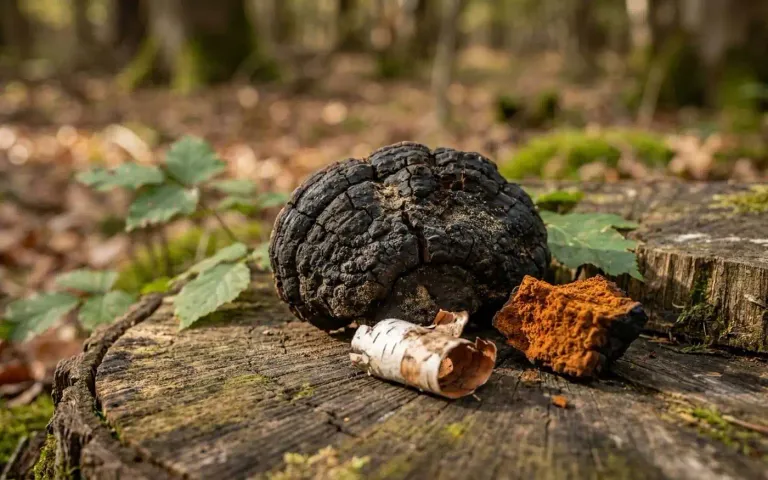
Chaga is a sterile conk: a hard, black growth of fungal mycelium and birch wood, not a fruiting body like lion's mane or reishi. Memorial Sloan Kettering Cancer Center describes it as a folk remedy in Russia and northern Europe, and you will now meet it as tea, powder, capsules and liquid extracts.
Read the grade column first, because it tells you how far each claim has travelled from a lab bench towards a person.
| Claim | Best evidence | Study type | Result | Grade |
|---|---|---|---|---|
| Antioxidant | Park 2004; Najafzadeh 2007 | Human cells in a dish | Less DNA damage in cells | Lab-and-animal only |
| Immune and inflammation | Mishra 2012; MSKCC | Mice | Less colitis inflammation | Lab-and-animal only |
| Post-exercise inflammation | Nieman 2024 | 20 cyclists, blend | Lower markers; nitrate credited | Limited |
| Blood sugar and cholesterol | Zhang 2021; MSKCC | Mice; enzyme tests | Altered sugar and fat handling | Lab-and-animal only |
| Liver protection | Zhao 2012 | Mice | Less chemical liver damage | Lab-and-animal only |
| Cancer | Géry 2018; MSKCC | Cell lines | More toxic to lung cancer cells | Not tested in humans |
| Fatigue | Yue 2015; MSKCC | Mice | Less fatigue | Lab-and-animal only |
| Brain | Ban 2025 | Alzheimer's mice | Better maze memory | Lab-and-animal only |
| Skin and hair | None located | No human trial | No result | Not tested in humans |
No row earns a 'Strong' grade, and that tells you where the field stands. Most online claims trace to reviews, such as a 2024 review in Mycology that lists anti-inflammatory, antioxidant, anticancer, anti-diabetic, hepatoprotective and anti-fatigue activity from chaga extracts. Those are lab activities, which are different from a benefit to you.
Preclinical means the work used cell cultures or animals before any human trial, and in vitro means in a dish. Neither tells you what happens when you drink the tea, and Memorial Sloan Kettering states that "the safety and efficacy of chaga have yet to be evaluated in clinical studies".
An authorised health claim is wording the regulator has approved for a label. The Great Britain nutrition and health claims register carries no entry for chaga in its spreadsheet dated 19 May 2026, so no UK brand can tell you that chaga boosts immunity as fact, and neither will I.
Antioxidant Effects: Strong in the Lab, Untested in People

If you have read that chaga is 'packed with antioxidants', the claim comes from a lab result. It is usually credited to polyphenols, plant-type compounds that can neutralise unstable molecules called free radicals, and to melanin, the dark pigment in chaga's black crust.
In a 2004 study by Park and colleagues, human lymphocytes (white blood cells, like those in your own blood) were pretreated with an aqueous chaga extract and then exposed to hydrogen peroxide. DNA fragmentation fell by over 40%.
A 2007 study by Najafzadeh and colleagues used lymphocytes from 20 people with inflammatory bowel disease and 20 healthy volunteers. An ethanolic chaga extract cut the peroxide damage by 54.9% in the patients' cells and 34.9% in the volunteers' cells.
These were cells in a dish, not people drinking tea. Nobody has shown that sipping chaga raises the antioxidant protection in your own blood.
Immune Support and Inflammation: What the Studies Actually Tested

On immunity, the research sits at an early stage. Memorial Sloan Kettering lists chaga's immunomodulating and anti-inflammatory effects as preclinical, and a 2012 mouse study by Mishra and colleagues found that an oral aqueous extract reduced acute inflammation in induced colitis.
The only randomised trial that included chaga does not help you much either. In a 2024 crossover trial by Nieman and colleagues, 20 cyclists took a beet-based supplement for two weeks, supplying 212 mg of nitrate, 200 mg of caffeine, 44 mg of vitamin C, B vitamins and 2.5 g of a mushroom blend containing cordyceps and chaga. Inflammation-related proteins were lower after 2.25 hours of cycling, and the authors credited the nitrate, so you cannot treat it as a chaga result.
Beta-glucans are fibre-like carbohydrates in mushroom cell walls that are often linked with the immune system. No trial has shown that chaga's beta-glucans change immunity in people, so if a label leads with 'immune support', you are reading marketing and not a result.
Blood Sugar, Cholesterol and Liver Claims: Animal Data Only
The blood sugar and cholesterol lines in Google's AI summary and on many health sites rest on mice and lab enzymes, so you should read them with that in mind. A 2021 mouse study by Zhang and colleagues found that a chaga extract regulated glycolipid metabolism, meaning how the body handles sugars and fats.
Memorial Sloan Kettering adds that chaga terpenoids inhibited the enzyme alpha-glucosidase in vitro, and may add to the effect of diabetes drugs. It calls the clinical significance "yet unknown", so you cannot rely on it. The liver claim has the same shape: a 2012 study by Zhao and colleagues found that chaga triterpenoids protected mice from chemical liver damage.
I found no human trial for blood sugar, cholesterol or the liver. If you take diabetes medication, speak to your GP before adding chaga.
Chaga and Cancer: Cell Studies, Not Treatment
If you or someone you love has cancer, read this section slowly, because chaga is often passed between patients by word of mouth and the research is much earlier than that suggests. In a 2018 laboratory study by Géry and colleagues, an aqueous chaga extract was more toxic to human lung cancer cells (A549) than to bronchial cells (BEAS-2B) after 48 and 72 hours.
That is a result in a dish, which is where research starts, and you should not read it as a treatment signal. Memorial Sloan Kettering likewise describes chaga's antitumour effects as preclinical.
Chaga is not a cancer treatment, and it should never replace prescribed care. The first published chaga kidney case, described below, was a woman taking chaga powder for liver cancer, so speak to your oncology team before taking any supplement.
Energy, Brain and Skin Claims
For energy, the evidence is thinner again. A 2015 study by Yue and colleagues looked at chaga polysaccharides and fatigue in mice, and mouse endurance cannot tell you how you will feel on a Monday morning.
For the brain, a 2025 study by Ban and colleagues gave an inotodiol-rich chaga extract called INO10 to mice bred to develop Alzheimer's-like disease. Maze memory improved, but four authors are employed by CARBOEXPERT Inc., the maker of the extract, so you should weigh it as a mouse study with a commercial link.
For skin and hair, I located no human trial. The antioxidant claims on skincare pages come from the lab work above, so they are untested on your skin.
Chaga Side Effects: Oxalate, Kidneys and Blood Thinners
Chaga looks gentle, and that is part of the problem. The Memorial Sloan Kettering patient section says there are no reports of side effects, but its professional section lists three kidney cases. Oxalate is a natural compound in plants and fungi that your kidneys clear from your blood, and too much of it can form crystals in kidney tissue and damage it.
In the first report, by Kikuchi and colleagues in 2014, a 72-year-old woman took 4 to 5 teaspoons of chaga powder a day for six months and developed oxalate nephropathy, and she started haemodialysis. A 2020 Korean report by Lee and colleagues described a 49-year-old man who took chaga powder for years for atopic dermatitis and reached end-stage kidney disease. Commercial chaga powders measured 2.8 to 14.2 g of oxalate per 100 g, and his estimated intake of 420 to 1,260 mg a day was two to five times a typical diet, well above what your own meals would supply.
A 2022 report by Kwon and colleagues involved a 69-year-old man taking 10 to 15 g of chaga powder plus 500 mg of vitamin C a day for three months. He developed acute kidney injury, and his kidney function recovered one month after haemodialysis and high-dose steroids.
In a 2026 rat study, three times the standard dose of chaga powder caused oxalate crystal deposits and tubular injury. Oxalate is rarely printed on extract labels, so you cannot check a bottle or a capsule for it.
Chaga may also affect bleeding. In a 2006 study by Hyun and colleagues, a chaga mycelium extract inhibited platelet aggregation in the lab and a purified peptide was active in mice. Memorial Sloan Kettering advises you to talk to your healthcare provider if you take blood thinners such as warfarin, because chaga "may increase your risk of bleeding".
Online reports of gut upset are anecdotes, so they cannot tell you how common it is, but call your GP if it happens to you. On the liver question, no chaga liver-injury case turned up in the sources I checked, and the liver-protection data are animal-only.
Who Should Not Take Chaga Without Medical Advice
- You have kidney disease or a history of kidney stones.
- You take warfarin, antiplatelet drugs or other blood thinners.
- You have surgery planned.
- You take diabetes medication.
- You are pregnant or breastfeeding, because there are no safety data.
- You are having cancer treatment and your team has not agreed.
If one of those applies to you, your GP or pharmacist is the right first call. Our guide to lion's mane side effects covers the safety questions that carry across medicinal mushrooms.
How People Take Chaga: Tea, Extracts and Chaga Coffee

The traditional way to take chaga is a hot-water tea brewed from pieces of the conk. You can also buy liquid extracts, and our guide to how to take mushroom tinctures walks you through them, while a mushroom powder is the other common route.
No trial has set a dose for you, so I cannot give you one. The kidney cases involved 4 to 5 teaspoons or 10 to 15 g of powder a day for months, so keep amounts modest and do not take high doses daily for long periods. No human trial has tested daily use, which makes an occasional cup the cleaner default.
Chaga coffee is where many people meet the mushroom without noticing. Many mushroom coffee blends include chaga, and the same oxalate caveat follows it into your cup, which is why some readers search for 'mushroom coffee without chaga'.
Our guide on whether mushroom coffee is good for you sets out the wider picture, and mushroom coffee vs regular coffee compares the two drinks. The ingredient lists in our best mushroom coffee brands roundup show you which blends skip chaga, and a guide to mushroom coffee side effects is planned.
Choosing a Chaga Product: Real Chaga, Fillers and Labels
If you still want chaga, the aim is to avoid paying for something that is not what the label says. A 2025 comparison of chaga supplements by Windsor and colleagues found that some North American products were mycelium grown on grain, starch-rich and lacking the triterpenoids and melanin profile of real chaga. Use this checklist before you buy.
- Real chaga named. Look for wild chaga canker or sclerotium, not just 'mycelium'.
- Beta-glucan stated. A stated figure tells you more than the word 'polysaccharides'.
- No grain listed. Oats, rice or other grain in the ingredients is a warning sign.
- Third-party testing. Ask for a certificate of analysis.
- Extraction method. A dual extraction uses water and alcohol, so it captures compounds either would miss, and our explainer on dual extraction goes further.
Balance Coffee is the company founded by James Bellis, who reviewed this article. Its Chaga Elixir is one example of a liquid extract, a 50 ml glass bottle from £39.99. Its product page gives no oxalate figure, so ask before you buy.
The guide linked at the top of this page ranks whole products, and the best mushroom tincture roundup covers liquid extracts. You may also be weighing chaga against lion's mane. Chaga is studied mainly for antioxidant and immune effects in the lab, while lion's mane is studied mainly for cognition, with small human trials, and lion's mane benefits grades that evidence in the same way.
The same graded guides are coming for reishi benefits and cordyceps benefits, and a guide to mushroom tincture benefits is planned. You are not falling behind on your health if you skip chaga, because a balanced plate and your medication taken as prescribed matter more than any bottle.
Studies Cited
Every study named above, so you can check my reading against the source.
- Park YK et al. Biofactors 2004
- Najafzadeh M et al. Biofactors 2007
- Mishra SK et al. J Ethnopharmacol 2012
- Nieman DC et al. Front Nutr 2024
- Zhang Z et al. J Ethnopharmacol 2021
- Zhao FQ et al. Yao Xue Xue Bao 2012
- Géry A et al. Integr Cancer Ther 2018
- Yue Z et al. J Tradit Chin Med 2015
- Ban S et al. Int J Mol Sci 2025
- Kikuchi Y et al. Clin Nephrol 2014
- Lee S et al. J Korean Med Sci 2020
- Kwon O et al. Medicine 2022
- Lee S et al. J Korean Med Sci 2026
- Hyun KW et al. Peptides 2006
- Windsor C et al. Int J Mol Sci 2025
- Ern PTY et al. Mycology 2024
- Memorial Sloan Kettering, chaga monograph, updated 20 February 2023
- Great Britain nutrition and health claims register, gov.uk
This article is for information and is not medical advice. Speak to your GP or pharmacist before taking chaga, especially if you have kidney problems or take medication.
Frequently Asked Questions
What does chaga do to your body?
In lab and animal studies, chaga acts as an antioxidant and dampens inflammation, but no clinical trial of chaga on its own has tested this in people. It is high in oxalate, which has been linked to kidney damage in three published cases. No UK health claim is authorised.
What not to mix with chaga?
Memorial Sloan Kettering advises caution with blood thinners such as warfarin, because chaga may increase bleeding risk. Diabetes medication is the other to watch, because chaga showed additive blood sugar effects in lab work, and high-dose vitamin C appeared in one kidney case report. Ask your GP or pharmacist before combining anything.
Who shouldn't take chaga?
Avoid chaga without medical advice if you have kidney disease or kidney stones, take blood thinners or diabetes medication, have surgery planned, or are pregnant or breastfeeding, because there are no safety data. Agree it with your oncology team first if you are having cancer treatment.
Should you take chaga every day?
No human trial has tested daily use, so nobody can call it safe. All three published kidney cases involved daily powder for months, at 4 to 5 teaspoons or 10 to 15 g a day in the two that gave amounts. If you still want chaga, keep amounts modest and avoid long daily high doses.
Is chaga hard on your liver?
No chaga liver-injury case turned up in the sources I checked, and mouse studies suggest liver protection, which is not proof for people. The organ with documented harm is the kidney, from oxalate. If you have liver disease, ask your specialist before taking any supplement.
Which is better, chaga or lion's mane?
Neither wins overall, because the evidence differs. Lion's mane is studied mainly for cognition, with small human trials, while chaga has only lab and animal data on antioxidants and inflammation. Our lion's mane guide grades that side in the same way, so read both before you choose.
Are there chaga benefits for women?
No benefit specific to women has been studied, and the general chaga claims rest on lab and animal work. There are no safety data for pregnancy or breastfeeding, so avoid chaga in both unless your clinician agrees. If a hormone or gut concern brought you here, a GP can look for causes a supplement would not address.
Is chaga good for your skin or hair?
No human trial on skin or hair was found. The antioxidant and melanin claims on skincare pages come from lab work, so they are untested on your skin. If you want to protect your skin, sunscreen has far better evidence than a mushroom.

A registered Nutritional Therapist and member of BANT, Clemmie blends science with a holistic approach to wellbeing.