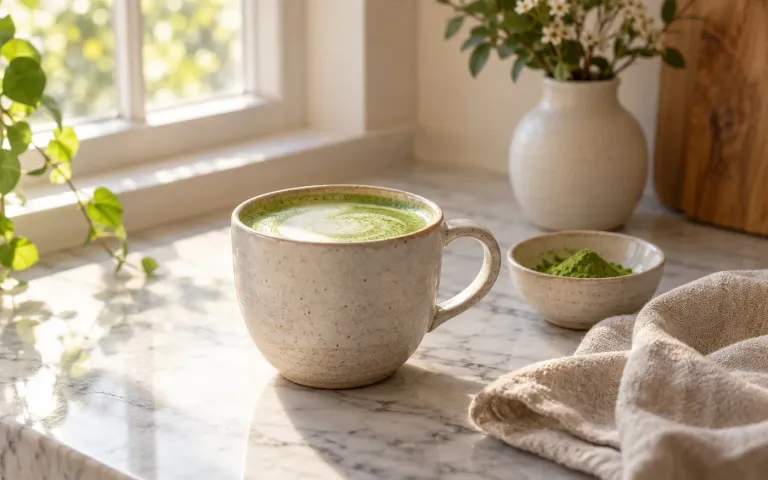
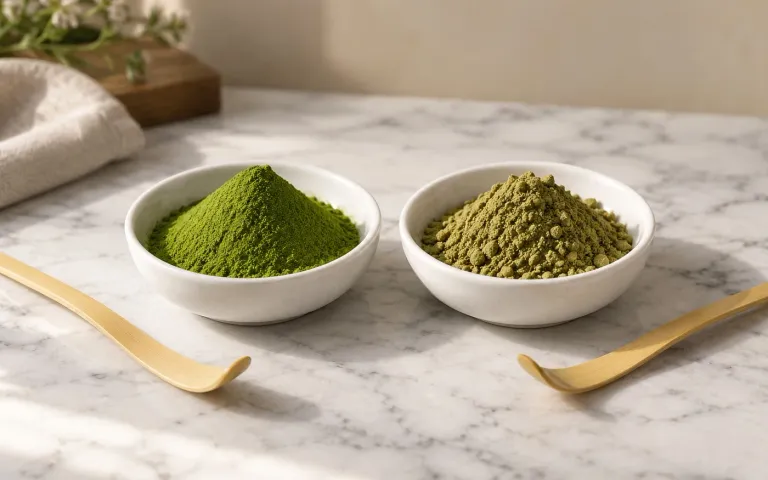
If you are wondering how much matcha per day is sensible, count it in grams: for most healthy adults the answer is 2 to 4 grams. Almost every page you will find answers in cups, which tells you little once the bowl you make at home and the latte you buy out are different sizes.
Most healthy adults can drink 2 to 4 grams of matcha a day, which is one or two traditional bowls or one cafe-style latte, and stay well inside the 400 mg daily caffeine limit that the European Food Safety Authority (EFSA) sets for adults. The real ceiling is total caffeine from every drink: lab-tested matcha carries roughly 19 to 44 mg of caffeine per gram, so about 9 grams on its own reaches 400 mg at the top of that range. Pregnant women should keep total caffeine under 200 mg a day, which is about 4.5 grams of the strongest matcha with nothing else caffeinated.
I have written about food and travel for over fifteen years, and this guide treats matcha as a daily drink habit rather than a supplement. I compared lab measurements of matcha caffeine and EGCG per gram with EFSA and NHS limits, then converted them into grams a day so you can weigh your own dose. If you are still choosing a tin, our guide to the best matcha brands in the UK covers that side.
How Much Matcha Per Day? The Short Answer
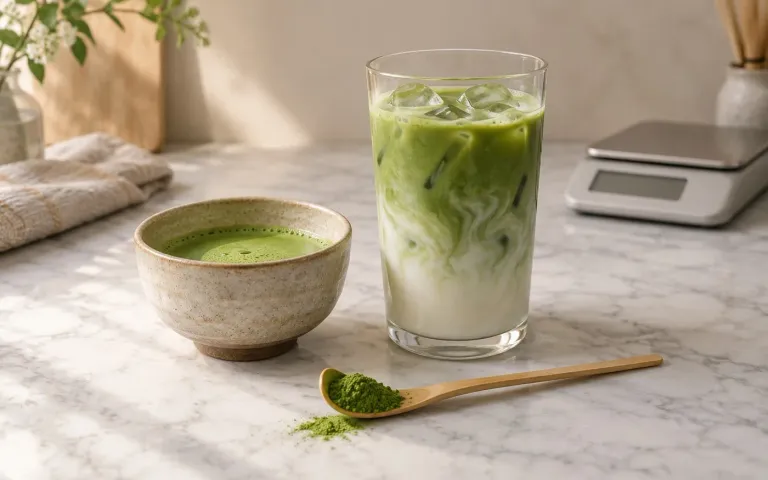
Plan on 2 to 4 grams a day, which is one or two traditional bowls or a single cafe-style latte. That sits comfortably inside what EFSA considers safe for healthy adults, and it leaves room for a coffee earlier in your day. If you remember three numbers, make them 2 g for a bowl, 4 g for a latte and 400 mg for the daily caffeine ceiling.
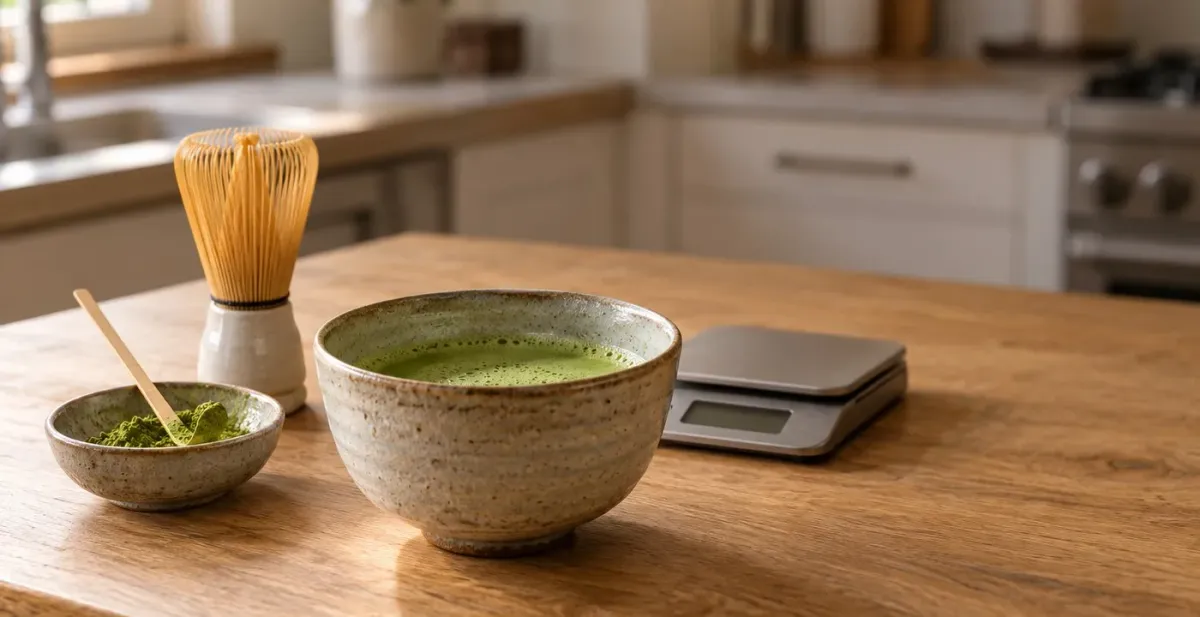
Advice such as '2 to 3 cups a day' means little until you know the grams behind it. A traditional bowl uses about 2 g of powder and a cafe-style latte often uses 4 g, so two people who each say 'one cup' can be drinking double the dose. Here, every limit becomes grams you can weigh on kitchen scales.
What One Serving Weighs: Bowl, Teaspoon and Latte
No authority sets an official serving weight for matcha, so the figures below are typical rather than fixed. Weigh your own scoop once and you will know your real dose from then on.
Serving
Typical weight
Where the figure comes from
Traditional thin bowl
2 to 3 g
Typical home preparation
Level teaspoon
About 2 g
Approximate, powder packs differently
Home or cafe-style latte
About 4 g
Common home recipes
Large chain latte
Unknown
Ask the cafe, do not guess
I have tasted my way through more than thirty countries, and the lesson that travels everywhere is that a cup is a vessel, not a measurement. A latte that doubles the powder doubles the dose, yet it still feels like the gentle option. A 4 g latte can carry 76 to 178 mg of caffeine, and the NHS lists about 100 mg in a mug of instant coffee, so your latte can out-weigh your coffee.
Grade matters too, because caffeine per gram changes with your powder. Our guide to ceremonial vs culinary matcha explains what you are paying for at each level. Our matcha latte recipe will show you how to hit 4 g without guessing.
The Caffeine Ceiling: Counting Matcha Into 400 mg
EFSA says intakes of up to 400 mg of caffeine a day, spread through the day, do not raise safety concerns for healthy adults, except pregnant women. That figure covers every source, so your coffee, tea, cola and matcha all draw from the same allowance. Single doses of up to 200 mg also raise no concern for healthy adults.
Sleep is the part you may overlook. EFSA notes that a single dose of 100 mg may affect sleep duration and patterns in some adults, particularly close to bedtime. A strong 4 g latte can pass that mark on its own.
The per-gram figure is wide, so your own tin could sit anywhere in it. A 2020 review in Molecules by Kochman and colleagues found 18.9 to 44.4 mg of caffeine per gram in matcha, against 11.3 to 24.67 mg per gram in green teas, and grade, harvest and leaf age all move the number.
In the market samples tested by Unno and colleagues in 2018, six matcha powders measured 37 to 44 mg per gram, while a seventh, low-grade powder measured about 6 mg per gram. That study also found that the matcha marketed overseas carried more caffeine and EGCG, and less theanine, than the Japanese samples.
Put those numbers on a scale and you get 1 g at 19 to 44 mg, 2 g at 38 to 89 mg and 4 g at 76 to 178 mg. Your 400 mg ceiling arrives at about 9 g of the strongest powder, or 21 g of the weakest. For milligrams in a single serving, and how matcha caffeine feels next to coffee, read our guide to how much caffeine is in matcha.
The Catechin Ceiling: EGCG and the EFSA Liver Opinion
EGCG is the main catechin in tea, the antioxidant most of the matcha attention is about. You drink the whole leaf, so you take in more of it than you would from a standard cup of green tea. That is why a second ceiling is worth checking.
In its 18 April 2018 opinion on green tea catechins, EFSA said doses of EGCG at 800 mg a day may be associated with initial signs of liver damage. That finding came from supplements, not from the tea you brew. EFSA considered catechins from green tea infusions brewed with hot water, and similar ready-to-drink teas, as generally safe, and it put the average daily EGCG intake from traditional green tea infusions at 90 to 300 mg.
Matcha sits higher per serving. Unno's samples held 48 to 87 mg of EGCG per gram, so 4 g gives you 194 to 347 mg, which is inside the 90 to 300 mg range of a typical green tea day at the low end and above it at the high end.
You will often read that matcha has '137 times' the EGCG of green tea. That number comes from one 2003 comparison by Weiss and Anderton against a single green tea, China Green Tips, and the same paper put matcha at least three times above the largest literature value for other green teas. It is one lab result that sellers have repeated far beyond what it measured.
I would rather you hear the plain version: the liver signal attaches to concentrated extract supplements, not to a bowl or a latte at normal amounts. For how whole leaf compares with an infusion, see our guide to matcha vs green tea.
Which Ceiling You Hit First
Put the two ceilings side by side and you can see how far each one sits from a normal day.
Ceiling
Daily figure
Strongest powder
Weakest powder
Caffeine (EFSA)
400 mg
9.0 g
21.2 g
EGCG (EFSA, supplements)
800 mg
9.2 g
16.5 g
Caffeine uses the Kochman range and EGCG the Unno range, so you are comparing two studies. In the six market samples, caffeine reached 400 mg at about 9 to 11 g, and EGCG reached 800 mg at about 9 to 17 g. Both limits sit above 9 g, more than twice a latte. In your real day, caffeine runs out first, because coffee or tea is usually already in it, which is why this guide counts in caffeine.
Is It OK to Drink Matcha Every Day?
Yes, for most healthy adults, as long as your total caffeine stays inside the budget above. EFSA treats catechins from brewed green tea as generally safe, and a steady daily bowl is kinder to you than a heavy weekend.
If you are curious how it feels, start with one bowl a day and note your sleep for a week. Energy is not something to chase, and a calm drink that never leaves you jittery is the one worth keeping. We cover what daily matcha may do for you in our matcha benefits guide.
Who Should Drink Less
A few groups should stay at the low end of the range or check first. If you recognise yourself below, treat the grams in this guide as a ceiling, not a target.
Pregnant or Breastfeeding
The NHS says you should not have more than 200 mg of caffeine a day while pregnant, and EFSA reports no safety concern for the foetus up to the same figure. At the strongest figure of 44.4 mg per gram, that is about 4.5 g of matcha with nothing else caffeinated. If you also have a mug of tea at about 75 mg, you have 125 mg left, which is under 3 g of matcha, so speak to your midwife or GP about your own limit, including while breastfeeding.
Low Iron or Anaemia
Tea catechins are known to reduce how much iron you absorb from plant foods, so timing matters if your iron is low. Keep matcha away from iron-rich meals and iron supplements, and ask your GP before you change anything. Spacing your drink out is a practical habit, not a clinical rule.
Caffeine-Sensitive Readers and Children
If caffeine already gives you anxiety, poor sleep or a racing heart, or you have a heart rhythm condition, aim for a single 2 g bowl or less and take your doctor's view first. EFSA proposes 3 mg per kilogram of body weight a day for children and adolescents, which a strong latte can use up quickly. Matcha is not a children's drink.
On Medication
If you take regular medication, speak to your GP or pharmacist before you make matcha a daily habit. I have not named any drug interactions here because none are established in the sources I used.
Signs You Have Had Too Much
Too much matcha shows up as jitters, a racing heart, poor sleep, or nausea when you drink it on an empty stomach. All of these are dose-related, so you can usually fix them by cutting the grams before you cut the habit. Drop from 4 g to 2 g, move your drink earlier, and see whether the symptoms go.
If a symptom stays after you cut back, speak to your GP. Our matcha side effects guide will cover the evidence for each effect.
When to Drink It: Timing, Sleep and Iron
Aim for the morning or early afternoon. EFSA's 100 mg sleep note is the reason, and a 4 g latte can carry more than that, so a late drink can cost you a night's sleep.
Keep matcha one to two hours away from iron-rich meals and iron supplements. If your stomach is sensitive, drink it with or after food rather than first thing on an empty stomach. Your body will tell you which routine suits it.
You Drink the Whole Leaf: What That Means for Contaminants
With a teabag, whatever the leaf absorbed from the soil mostly stays in the pot. With matcha, you swallow the leaf. A 2015 study by Li and colleagues in Environmental Monitoring and Assessment tested green tea from Jiangxi and found that lead, cadmium, copper and aluminium mainly remained in the leaves, while the infusions stayed below drinking-water limits.
That study measured green tea, not matcha, so treat it as a reason for you to ask questions rather than a verdict. The leaves averaged 487.57 mg per kilogram of aluminium and 0.92 mg per kilogram of lead. I am not calculating a risk from those figures, because the sources I used give no verified tolerable intake to set them against.
Treat this as a sourcing choice for you, not a scare. A 2026 review by Unno, Kameoka and Nakamura notes that matcha products range widely in quality, from high-grade ceremonial products to lower-quality powders. Look for a traceable origin and brands that publish lab results, and start with our roundup of the best ceremonial grade matcha.
Matcha and Coffee in One Day: Your Caffeine Budget
Most matcha drinkers also drink coffee, and the two share one allowance. Add them up the way you would a bank balance.
Your day
Caffeine
Against 400 mg
One mug of instant coffee plus one 4 g latte
176 to 278 mg
Inside
Two 4 g lattes, no coffee
152 to 356 mg
Inside
Two 4 g lattes plus one mug of instant coffee
252 to 456 mg
Can pass it
The coffee figure is the NHS's 100 mg for a mug of instant. If your second drink pushes you over, swap the afternoon coffee for decaf and the second latte fits. Our best decaf coffee beans roundup shows you where to start, and matcha vs coffee helps you decide which to keep as your main drink.
Matcha by the Gram: Reference Table
Use this table to check any dose you weigh. Caffeine uses 18.9 to 44.4 mg per gram and EGCG uses 48 to 87 mg per gram, and the last column shows the share of 400 mg at the top caffeine figure.
Grams
Caffeine
EGCG
Share of 400 mg
1 g
19 to 44 mg
48 to 87 mg
11%
2 g
38 to 89 mg
97 to 174 mg
22%
4 g
76 to 178 mg
194 to 347 mg
44%
6 g
113 to 266 mg
291 to 521 mg
67%
8 g
151 to 355 mg
388 to 694 mg
89%
Matcha is a ritual worth keeping, and one weighed bowl is a good place to begin. Start with 2 g, notice how you feel, and let the scale rather than the cup guide you.
Frequently Asked Questions
Is 2 teaspoons of matcha a day too much?
No for most adults. Two teaspoons is about 4 g, which carries roughly 76 to 178 mg of caffeine, inside EFSA's 400 mg limit. Count any coffee or tea on top, because they share the same allowance, and halve your intake if you are pregnant.
How many matchas can you consume in a day?
Two traditional bowls or one cafe-style latte, which is 2 to 4 g, suits most adults. Your real ceiling is total daily caffeine, which the strongest matcha reaches at about 9 g with nothing else caffeinated. You will hit it sooner once coffee is in your day.
Is it safe to consume matcha every day?
Yes for most healthy adults within the caffeine budget, and EFSA considers catechins from brewed green tea generally safe. If you are pregnant, low in iron or taking medication, check with your GP first. They can tell you whether a daily habit fits your own health.
Is there a downside to drinking matcha?
The downsides are dose-related: caffeine jitters and poor sleep at high intakes, reduced iron absorption near meals, and swallowing whatever the leaf absorbed, so sourcing matters to you. Keeping to 2 to 4 g avoids most of them. Our guide to matcha side effects will go through each one in detail.
What is the best time to drink matcha?
Morning to early afternoon suits most people. EFSA notes that 100 mg of caffeine close to bedtime may affect sleep in some adults, and a 4 g latte can carry more than that. If you are sensitive, finish your last bowl by lunchtime.
What not to mix with matcha?
Keep it apart from iron-rich meals and iron supplements, which matcha's catechins can interfere with. Do not stack it with other caffeine sources such as coffee, energy drinks or pre-workout powders beyond your daily budget. Ask your GP or pharmacist about medication.
How much matcha per day for weight loss?
No dose has been proven to cause weight loss, so there is no special amount for you to aim for. Stay inside the same 2 to 4 g range as everyone else and treat any weight effect as a bonus. Our matcha for weight loss guide will look at what the research does show.
How many matcha lattes a day is too much?
At 4 g each, two lattes can reach 356 mg of caffeine at the strong end, and with one coffee on top you can pass 400 mg. One latte a day is the comfortable default. A second fits only if you drop other caffeine.
How much matcha can I have while pregnant?
Keep total caffeine under 200 mg a day, which is about 4.5 g of the strongest matcha with nothing else caffeinated, or under 3 g if you also have a mug of tea. These are ceilings, not targets. Check your own limit with your midwife or GP.
Does matcha count towards my daily caffeine limit if I also drink coffee?
Yes. EFSA's 400 mg covers caffeine from all sources. A mug of instant coffee, about 100 mg, plus a 4 g latte comes to 176 to 278 mg, and you can swap a second coffee for decaf to fit a second matcha.