De’Longhi Rivelia Review: Is the Bean-Switch Machine Worth It?

Coffee & Wellness Writer
Two hoppers, one press. I calibrated commercial machines for two years - this is whether the Bean Switch holds the dial.

Table of Contents
Some of the links in this article are affiliate links, which help fund our independent review work at no extra cost to you. Every recommendation is based on hands-on testing through The Editor Lab methodology. No brand pays to appear, and no placement is guaranteed.
Swapping a commercial bean-to-cup machine onto a different coffee used to cost me fifteen minutes. Empty the hopper, run the grinder clear, reset the grind, re-check the dose, pull a test shot, then adjust again. I did that hundreds of times across corporate accounts during two years calibrating bean-to-cup machines for UCC Coffee. So when De’Longhi built a machine whose entire identity is moving between two beans at the press of a button, the first thing I wanted to know was whether it actually holds the dial.
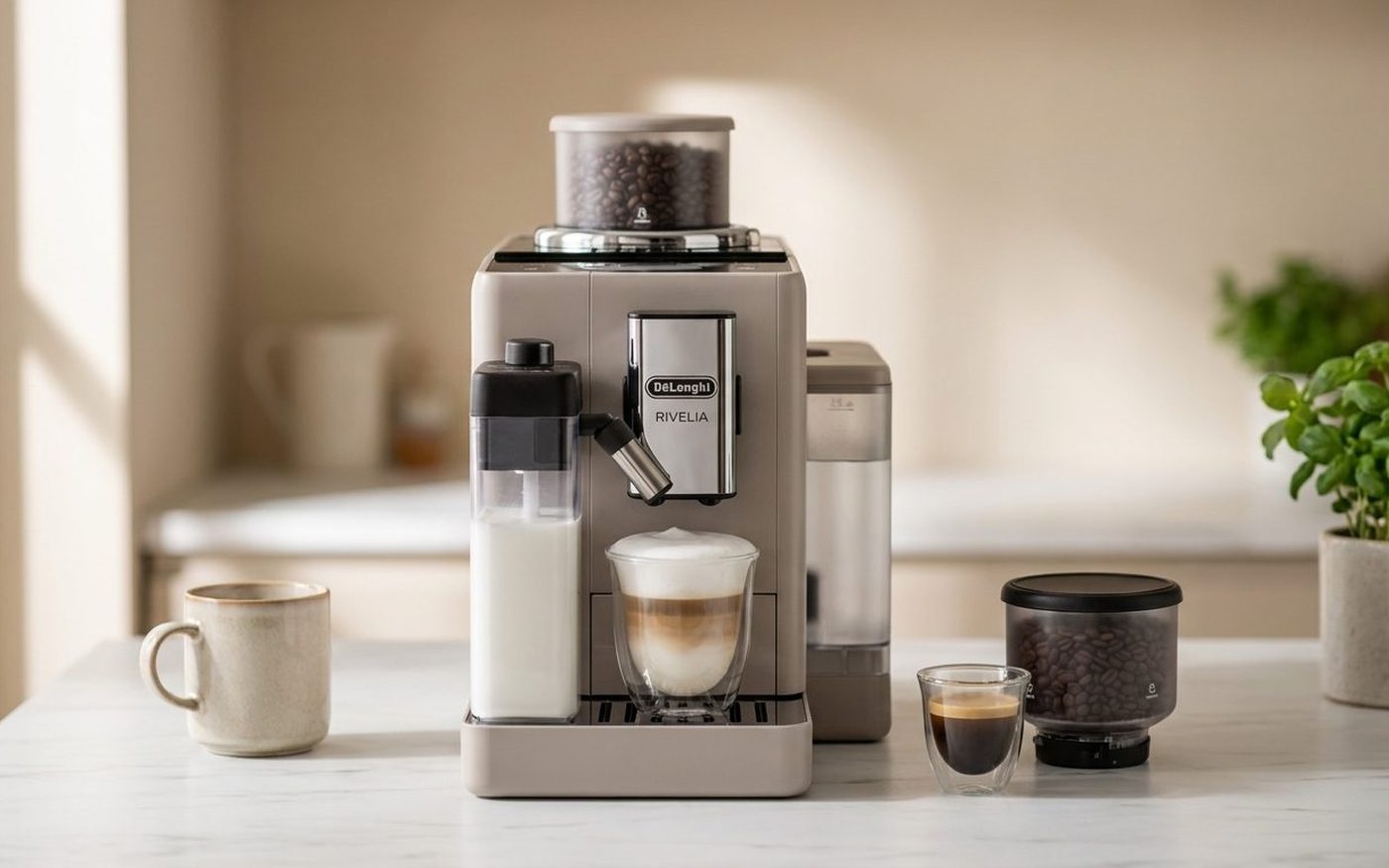
That is the question this De’Longhi Rivelia review answers. The Rivelia is De’Longhi’s compact, design-led bean-to-cup machine, launched in 2024, and its headline feature is the Bean Switch: two interchangeable 250g hoppers that let you move between two different coffees without emptying the machine. I tested it against three questions - whether the Bean Switch keeps two beans consistently dialled in, how the coffee and milk hold up in the cup, and whether the slim body earns its place on a real kitchen counter. If you are weighing it against the rest of the line-up, our best De’Longhi coffee machine guide ranks every current model; this review goes deep on one.
Editor's Note
James Bellis has spent 14 years in coffee. That includes two years at UCC Coffee calibrating commercial bean-to-cup machines - Jura, Thermoplan, and Eversys - across hundreds of UK corporate sites, adjusting grind, dose, temperature, and milk texture by hand. He went on to spend five and a half years inside the espresso machine manufacturer Sanremo UK, trained by their engineers. He reviews bean-to-cup machines from the calibration side, not the spec sheet.
Verdict: Is the De’Longhi Rivelia Worth It?
Score: 8 / 10. Recommended, with one honest caveat about milk temperature.
The Rivelia is worth buying if you want a genuinely compact bean-to-cup machine and you like the idea of running two coffees side by side. The Bean Switch is not a gimmick. It works, and it holds grind and dose well enough that I would use it daily. The coffee is good for the category, the milk foam is consistent, and at 24.5cm wide the machine answers the biggest objection people raise about bean-to-cup machines: that they take over a kitchen.
Where it stumbles is milk temperature. The Rivelia serves milk warm rather than hot, around 60C, and no setting fully closes that gap. If you drink flat whites, you will not mind. If you want a cappuccino that stays hot to the last sip, you will, and you should read the milk section below before you commit.
- Buy it if: counter space is tight, and you want to keep two beans on the go.
- Skip it if: hot milk is non-negotiable, or you make six drinks back to back every morning.
Price: RRP £749.99; widely sold for around £629 to £699 (verified May 2026).
Retailers: De’Longhi (from £749.99), Amazon UK (from £699), Currys (from £629), John Lewis (from £649 with a two-year guarantee).
The Bean Switch: Genuinely Useful or a Gimmick?
I expected the Bean Switch to be the kind of feature that photographs well and gets used twice. Most coffee machine novelties are. This one changed my mind.
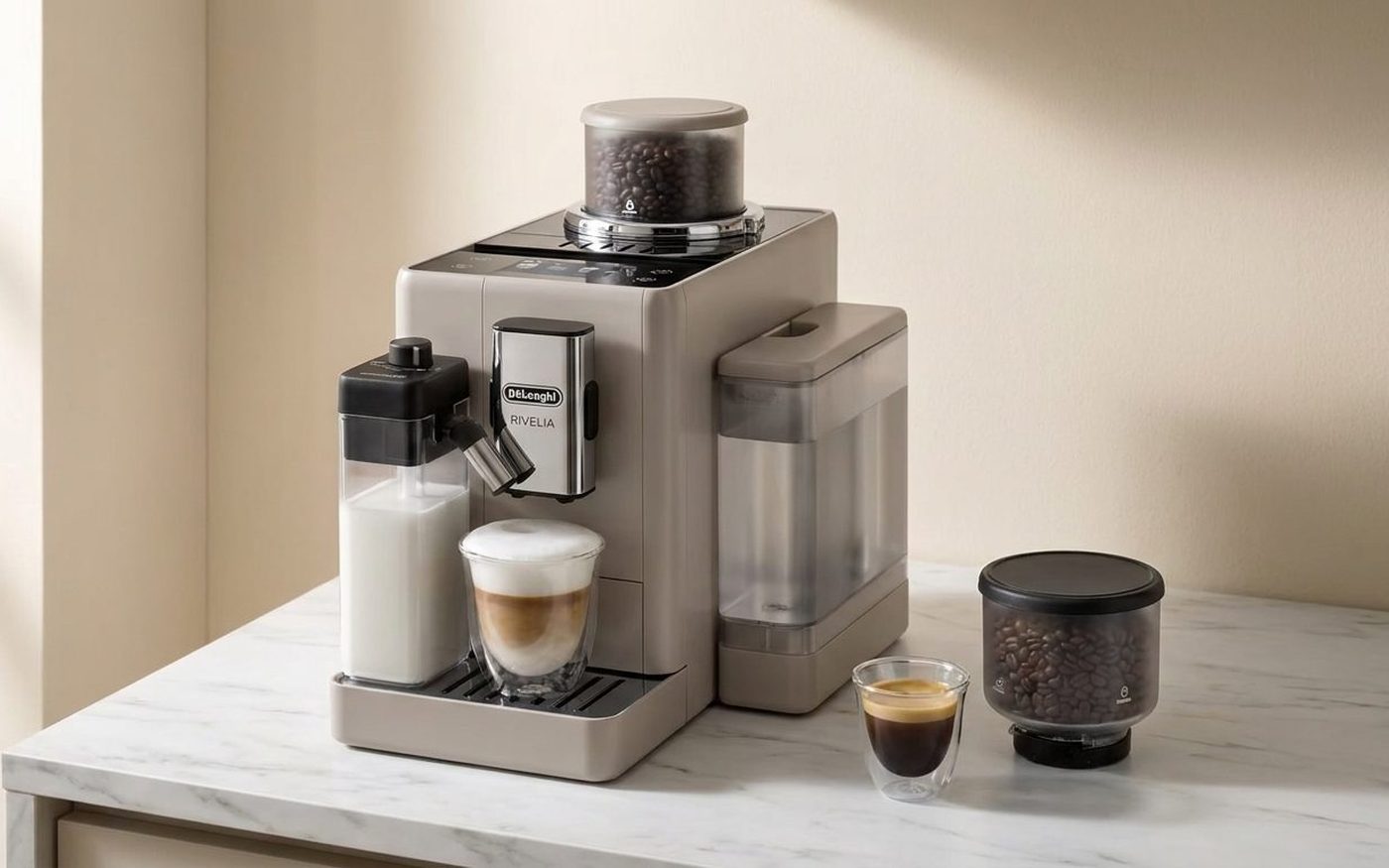
Here is how it works. When you want to change coffee, you put the machine into Switch mode, which empties the grinder of the current bean - you either make one last coffee with it or grind it away. You then lift one 250g hopper off, click the other into place, and the machine pulls up that bean’s stored profile. De’Longhi’s Bean Adapt Technology holds a separate grind, dose, and temperature setting for each bean, so a dark espresso roast and a brighter single origin each keep their own dial.
That clearing step is the part that matters, and the part most reviewers skip past. Every time I moved a commercial machine onto a new coffee at UCC, the slow job was clearing the old grounds out of the chute and burr chamber so the new bean was not contaminated. Because the Rivelia clears the grinder before each swap and each bean has its own saved profile, dose and grind stay genuinely consistent across a switch, and you are not re-dialling anything. That is real engineering, not a marketing flourish.
It earns its place, but be honest with yourself about the trade. Each hopper holds only 250g, which is a small amount of coffee, so a household making two or three drinks a day will be topping the hoppers up every few days. Two beans also means two small hoppers rather than one larger fixed one, and the swappable design adds moving parts a sealed hopper does not have. The feature is worth having; it just comes with smaller capacity and a little more to handle.
One practical note: the Bean Switch only pays off if you genuinely want two coffees on rotation, such as an espresso bean in one hopper and a smoother lungo-friendly bean in the other. For bean ideas suited to a machine at this level, our guide to the best coffee beans UK is a good starting point.
Coffee Quality: What Is in the Cup
Strip away the Bean Switch and you still have a bean-to-cup machine that has to make a decent espresso. The Rivelia does.
Its grinder is a conical steel burr unit, and for a machine in this class it is consistent. Crema came out reliably across medium and dark roasts in testing, with a steady stream and an even pour. I run a Niche Zero grinder at home, so I will not pretend an integrated bean-to-cup grinder matches a dedicated one for particle uniformity - it does not, and no machine at this price will. What it does do is grind cleanly and repeatably, which for a one-touch machine is the standard that counts.
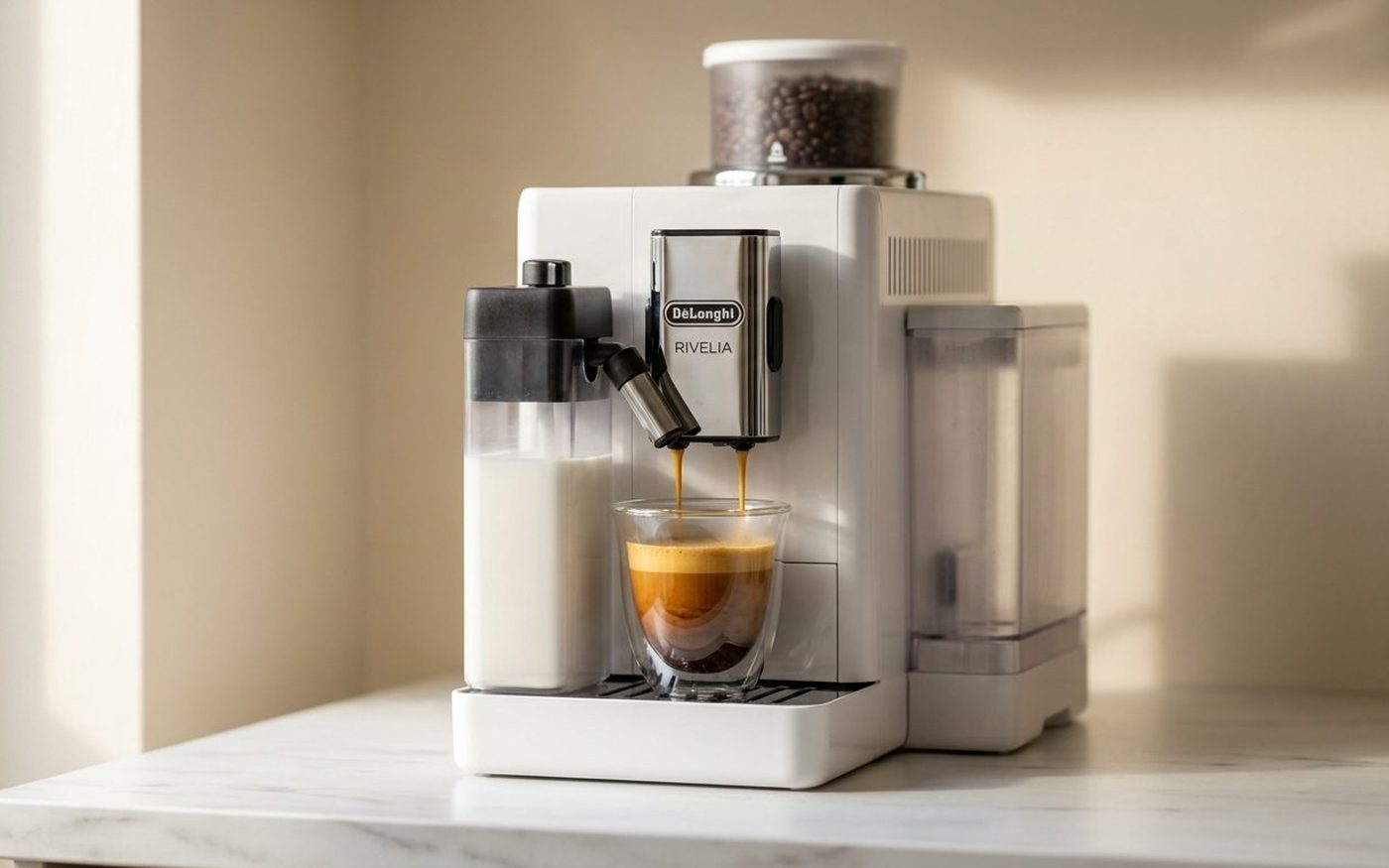
On heat, the Rivelia uses a thermoblock system, which warms quickly and holds a workable brew temperature for back-to-back drinks. The Specialty Coffee Association sets the ideal brew water window at roughly 90 to 96C, and the Rivelia sits inside it. When I was trained by Sanremo’s engineers, temperature stability was the variable we measured most closely, because it is where cheaper machines drift. A thermoblock is not a commercial dual boiler, but for a home machine making a few drinks a session, it is stable enough that you will not taste the difference.
What the automation costs you is the last layer of precision. A skilled hand on a manual machine can read a shot and adjust mid-pour; the Rivelia cannot, so the espresso tastes rounder and a little less defined than a carefully pulled manual shot. That is the bean-to-cup trade in every machine of this type, not a Rivelia fault. If you want consistent, genuinely good coffee with no technique on your part, it delivers.
The Milk System
Milk temperature is the one place the Rivelia will divide buyers, so here it is plainly: the milk comes out warm, not hot. Measured by owners and reviewers alike, it lands around 60C, and no setting fully changes that.
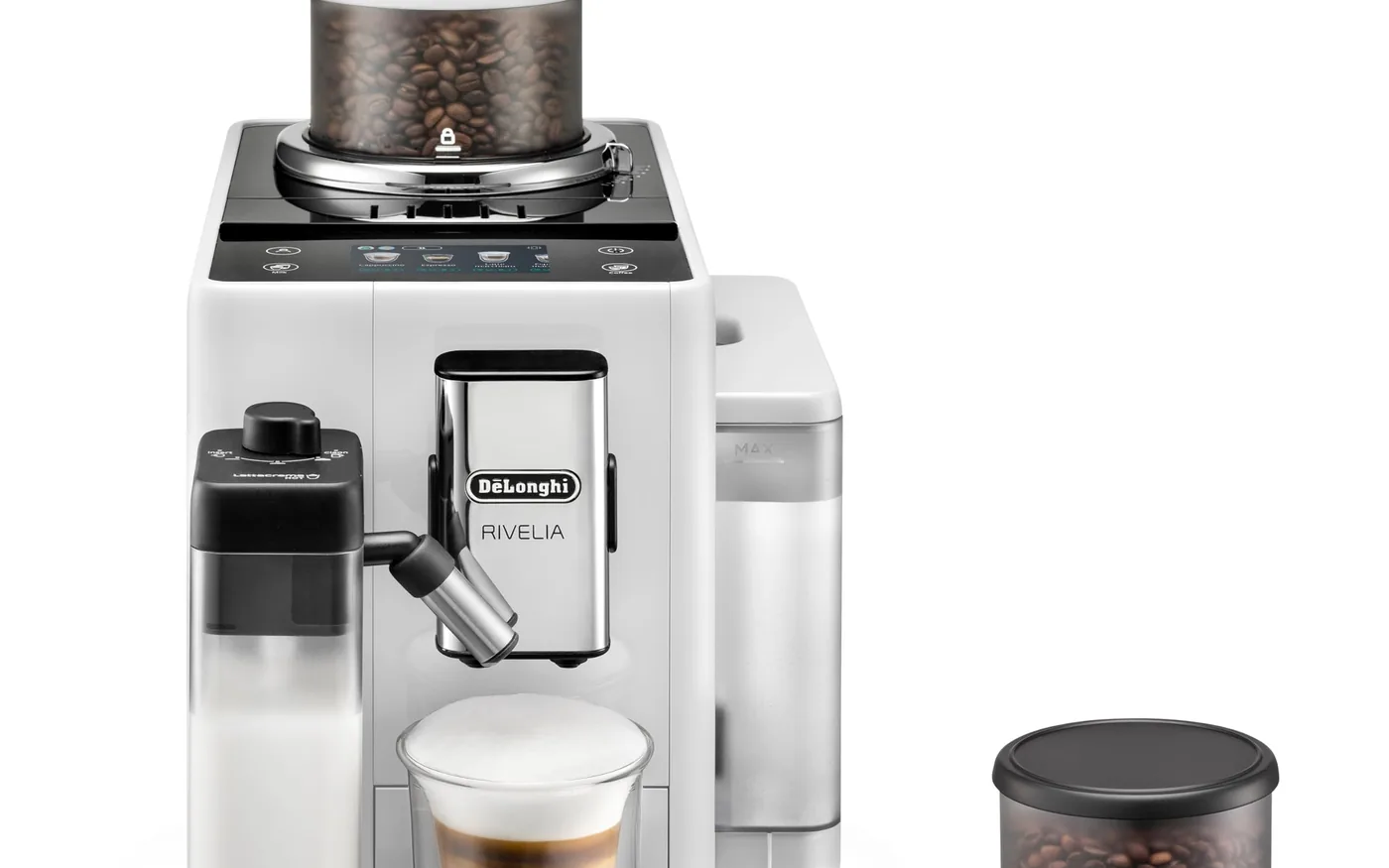
Mechanically, the system is good. The Rivelia uses De’Longhi’s LatteCrema carafe, an automatic milk unit with a foam dial that lets you set the texture from a flat, latte-style pour to a denser cappuccino foam. In testing it produced consistent micro-foam with a fine, even texture, and handled both dairy and oat milk without fuss. As carafe milk systems in this price band go, it is one of the better ones.
That temperature ceiling is structural, not a defect. On the commercial bean-to-cup machines I worked on at UCC, milk was textured by a steam wand at high boiler pressure, which is what gets it genuinely hot; a carafe system like the Rivelia’s heats milk as it passes through the unit, and that brief contact tops out lower. Around 60C is warm enough to drink straight away and, for a flat white, arguably the right temperature for tasting the coffee. For a cappuccino you want piping hot it will disappoint, and turning the temperature setting up narrows the gap without closing it.
Be clear-eyed about this before you buy. It is the most common complaint Rivelia owners raise, and it is fair. De’Longhi also sells a separate LatteCrema Cool carafe for cold foam and iced drinks, but that is a paid add-on at over £100, not something in the box. If hot milk is the thing you care about most, the Rivelia is not your machine.
Design and Footprint
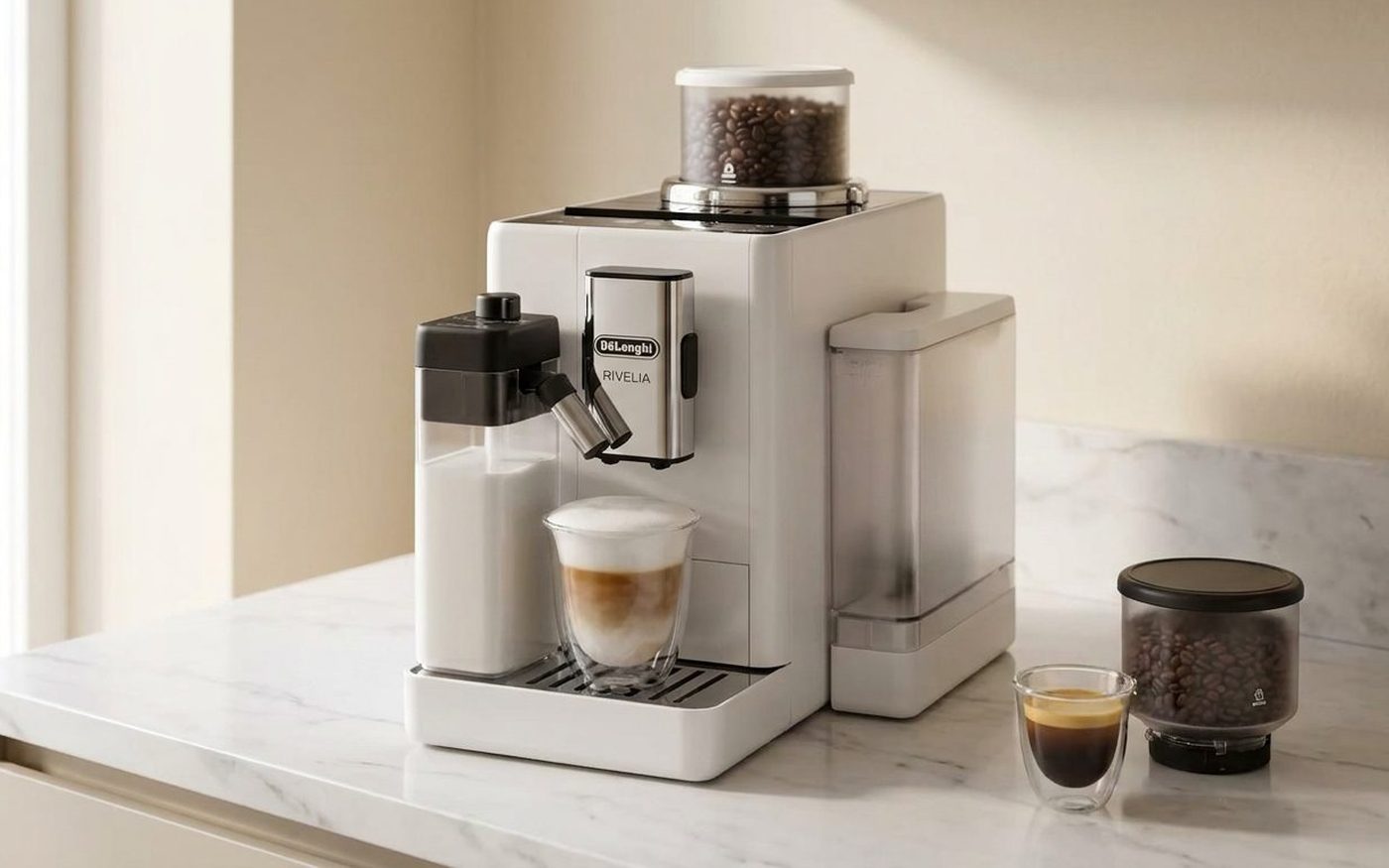
At 24.5cm wide, the Rivelia is narrow. That single number is the strongest argument for buying one. Most bean-to-cup machines are bulky appliances that claim a permanent stretch of worktop; the Rivelia is built to sit in a kitchen without dominating it, and it succeeds.
Measured in full, it is roughly 24.5cm wide, 38.5cm tall, and 43cm deep, at around 9.7kg. Width is where it wins. Depth is where you still need to check your counter: 43cm is a normal bean-to-cup depth, so if your worktop is tight front to back, measure before you order. The design is clean and modern, with a 3.5in colour touchscreen instead of buttons, in four finishes: Onyx Black, Pebble Grey, Sand Beige, and Arctic White.
If a small kitchen is the reason you have held off on a bean-to-cup machine, this is the one that removes the objection. You trade some bean and water capacity for the slim body, which is a fair swap when space is your constraint.
Living With the Rivelia: Cleaning and Known Problems
Day to day, the Rivelia is straightforward to live with, though the Bean Switch design gives you a little more to clean than a single-hopper machine. The brew unit pops out for a rinse under the tap, which is the right design and keeps maintenance honest. The LatteCrema carafe needs a rinse cycle after milk drinks, and the machine prompts you for it.
Descaling is the maintenance job that matters most. With typical UK tap water, plan on descaling every couple of months under regular daily use; the touchscreen prompts you when a cycle is due. Skipping it is the fastest way to shorten a thermoblock machine’s life, so do not put it off. De’Longhi’s official support pages carry model-specific descaling and cleaning guidance, and it is worth following theirs rather than a generic routine.
On known problems, owner feedback is reassuring rather than alarming, and the milk temperature point covered above is the headline gripe by a wide margin. Beyond that, a minority of owners report occasional touchscreen responsiveness quirks. The Switch mechanism itself has not thrown up a pattern of failures in its first couple of years on sale, though it is a newer design with a shorter track record than De’Longhi’s long-running lines. Handle the hoppers with care, keep up with descaling, and you should get years of service from it.
Rivelia vs Dinamica: Which One
| De’Longhi Rivelia | De’Longhi Dinamica | |
|---|---|---|
| Bean storage | Two interchangeable 250g hoppers | Single hopper, around 300-400g |
| Bean Switch | Yes | No |
| Water tank | 1.4L | 1.8L |
| Display | 3.5in colour touchscreen | LCD or touch, varies by model |
| Footprint | Slim, design-led (24.5cm wide) | Conventional bean-to-cup body |
| Milk system | LatteCrema carafe (automatic) | LatteCrema carafe or manual wand, varies by model |
| Typical price | RRP £749.99 | From around £400 on standard models |
By contrast, the Dinamica gives you a single larger bean hopper, a bigger water tank, and, on standard models, a lower price. It is the more conventional machine: fewer fills, less to handle, and good value. The Rivelia asks you to accept smaller capacity in return for the slim body and the Bean Switch.
So the choice is genuinely about what you want. Choose the Rivelia if counter space is tight, or if running two beans appeals enough to justify the premium; choose the De’Longhi Dinamica if you would rather have one bigger hopper, a larger tank, and money left over. Below both sits the cheaper Magnifica line, which uses the same brewing approach in a more basic package, and our De’Longhi Magnifica review covers that range in full. For the picture across brands, a best bean to cup coffee machine UK roundup is the wider comparison.
Who the De’Longhi Rivelia Is For
The Rivelia is a specific machine for a specific buyer, and it is better to be honest about that than to call it right for everyone.
It is for you if your kitchen is short on space and a slim machine is the difference between owning a bean-to-cup machine and not. It is for you if you genuinely want two coffees on rotation - a decaf and a regular, or an espresso roast and a smoother everyday bean - because the Bean Switch makes that effortless. It is for you if you want good, consistent coffee at the press of a button and you drink flat whites or lattes, where milk at 60C is fine.
It is not for you if hot milk is the thing you care about most, because the warm-milk ceiling is real and permanent. It is not for you if you run a busy household making many drinks back to back, where the 250g hoppers and 1.4L tank will have you refilling often. And it is not for you if you want the lowest price for the function - a single-hopper Dinamica, or stepping across to best espresso pods for a no-maintenance option, will both cost less. If you would rather chase the highest possible cup quality and enjoy the craft, that is a manual setup from a best espresso machine guide, not a super-automatic.
Full Specifications
| Specification | Detail |
|---|---|
| Model range | EXAM440.55 (.B Onyx Black, .G Pebble Grey, .BG Sand Beige, .W Arctic White) |
| Machine type | Super-automatic bean-to-cup |
| Bean hoppers | Two interchangeable 250g hoppers (Bean Switch) |
| Grinder | Conical steel burr, 13 grind settings |
| Heating system | Thermoblock |
| Milk system | LatteCrema carafe, automatic, with foam dial |
| Drinks menu | 16 pre-set recipes |
| Display | 3.5in colour touchscreen |
| Smart features | Bean Adapt Technology, up to 4 user profiles |
| Water tank | 1.4L |
| Dimensions | Approx. 24.5cm W x 38.5cm H x 43cm D |
| Weight | Approx. 9.7kg |
| RRP | £749.99 (street price around £629 to £699, May 2026) |
The Verdict
The De’Longhi Rivelia set out to do two things: shrink the bean-to-cup machine to a size that fits a real kitchen, and make running two beans effortless. It does both. The Bean Switch is the rare gadget feature that holds up to scrutiny, because the grinder-clearing step is properly engineered and grind and dose stay consistent across a swap.
It does not, however, serve hot milk, and at this price that caveat is worth stating without softening it. Score it 8 out of 10: a confident, well-judged machine for the buyer who wants compact size and bean variety, and the wrong machine for anyone who wants their cappuccino piping hot. Independent testers such as Which? reach a similar split verdict. Buy it for the right reasons and you will be happy with it.
Frequently Asked Questions
Is the De’Longhi Rivelia worth it?
Yes, for the right buyer. At an RRP of £749.99, it is worth it if you want a genuinely compact bean-to-cup machine and you value switching between two beans. The Bean Switch works well and the coffee is good for the category. It is harder to justify if you want piping-hot milk or a large capacity, where a conventional machine does more for less.
What is the Rivelia Bean Switch?
The Bean Switch is De’Longhi’s dual-hopper system. The Rivelia has two interchangeable 250g bean hoppers, so you can move between two different coffees without emptying the machine. A Switch mode clears the grinder before each swap, and Bean Adapt Technology stores a separate grind, dose, and temperature profile for each bean, so both stay dialled in.
Is the Rivelia better than the Dinamica?
Neither is better outright; they suit different buyers. The Rivelia has a slimmer body and the two-hopper Bean Switch. The Dinamica has a single larger bean hopper, a bigger 1.8L water tank, and a lower starting price on standard models. Choose the Rivelia for compact size and bean variety, and the Dinamica for capacity and value.
Does the De’Longhi Rivelia make hot milk?
Not piping hot. The Rivelia’s LatteCrema carafe produces consistent micro-foam, but the milk comes out warm rather than hot, at around 60C, and no setting fully changes that. It is fine for flat whites and lattes. If you want a cappuccino that stays hot to the last sip, this is the machine’s main limitation.
How big is the De’Longhi Rivelia?
It measures roughly 24.5cm wide, 38.5cm tall, and 43cm deep, and weighs about 9.7kg. The 24.5cm width is its standout feature and makes it one of the more compact bean-to-cup machines available. Note that the 43cm depth is standard for the category, so check your counter depth before buying.
A wellness entrepreneur and biohacker, James explores the intersection of hospitality and health - from clean fuel and recovery tools to mindful routines that build balance into daily life.