Sage Barista Touch Impress Review: Is It Worth £999 in 2026?

Coffee & Wellness Writer
Sage Barista Touch Impress reviewed by a former Sanremo UK specialist. Honest verdict on the Impress puck system, AutoMilk, and whether £999 is justified.
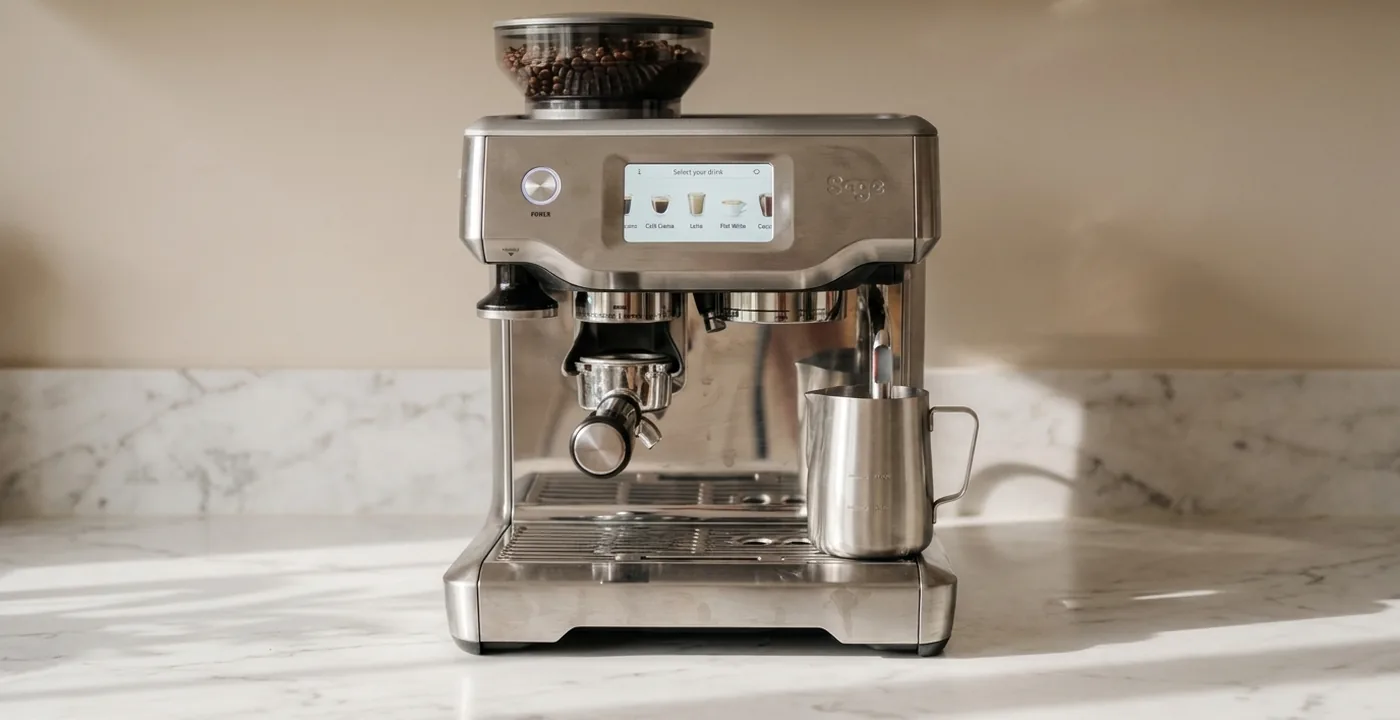
Table of Contents
Some of the links in this article are affiliate links, which help fund our independent review work at no extra cost to you. Every recommendation is based on hands-on testing through The Editor Lab methodology. No brand pays to appear, and no placement is guaranteed.
The most counterintuitive thing about the Sage Barista Touch Impress is that its most valuable feature is not the touchscreen. Most coverage leads with the interface. The AutoMilk system gets its own dedicated section. But the Impress Puck System - the grind-by-weight and auto-tamping mechanism that runs before every shot - is where the actual consistency gains live. If you are spending £999 on this machine, you should understand what is doing the work.
This review assesses the Touch Impress from an extraction standpoint: what the Impress system changes in practice, where the AutoMilk texturing has a ceiling, and whether the machine sits convincingly between the Express Impress and the Oracle Touch in the Sage lineup. If you have not yet settled on this machine specifically, the best Sage coffee machine guide gives you the full ranked picture across the range.
Editor's Note
I started in coffee in 2012, working as a barista trainer before moving into espresso machine sales at Sanremo UK, an Italian manufacturer whose machines you find in specialty roasteries from Edinburgh to Exeter. Over five and a half years, I held 60 UK roastery accounts and visited close to 300 roasteries across the country, while being trained by Sanremo's own engineers on PID control units, multi-boiler systems, and temperature stability. I have assessed the Barista Touch Impress using The Editor Lab - Balance Journal's structured evaluation framework for coffee equipment, which measures extraction quality, grinder performance, steam consistency, and build quality against professional standards.
Quick Verdict
The Sage Barista Touch Impress earns its premium over the standard Barista Touch, but only if you are willing to let the machine manage your tamping. The Impress system removes dose variation and tamp inconsistency from your workflow, and in doing that, it removes the two most common sources of shot-to-shot variance in home espresso. The AutoMilk texturing is consistent for flat whites and cappuccinos, though your latte art ceiling is lower than on a machine with a manual wand.
The case against is simple: at £999, you are paying for automation rather than a higher extraction ceiling. The grinder is competent rather than exceptional. The ThermoJet heats up fast. The touchscreen is a convenience, not a quality upgrade. For the right buyer, those trade-offs are worth it. For the wrong one, they add up.
Score: 8.0 / 10
| Best for | Home espresso drinkers who want consistent shots without manual dialling |
| Skip if | You want full manual control or are buying primarily for latte art |
| Price (May 2026) | £999 (verify: sageappliances.com/uk) |
| Where to buy | Sage Barista Touch Impress on Amazon UK |
| Pros | Cons |
|---|---|
| Grind-by-weight removes dose guesswork | AutoMilk limits latte art ceiling |
| Impress system standardises tamp pressure | £999 for a single-boiler machine |
| ThermoJet reaches temperature in seconds | Grinder adequate, not exceptional |
| AutoMilk consistent for flat whites and cappuccinos | Limited manual override on milk texturing |
Sage Barista Touch Impress: Key Specs and Features
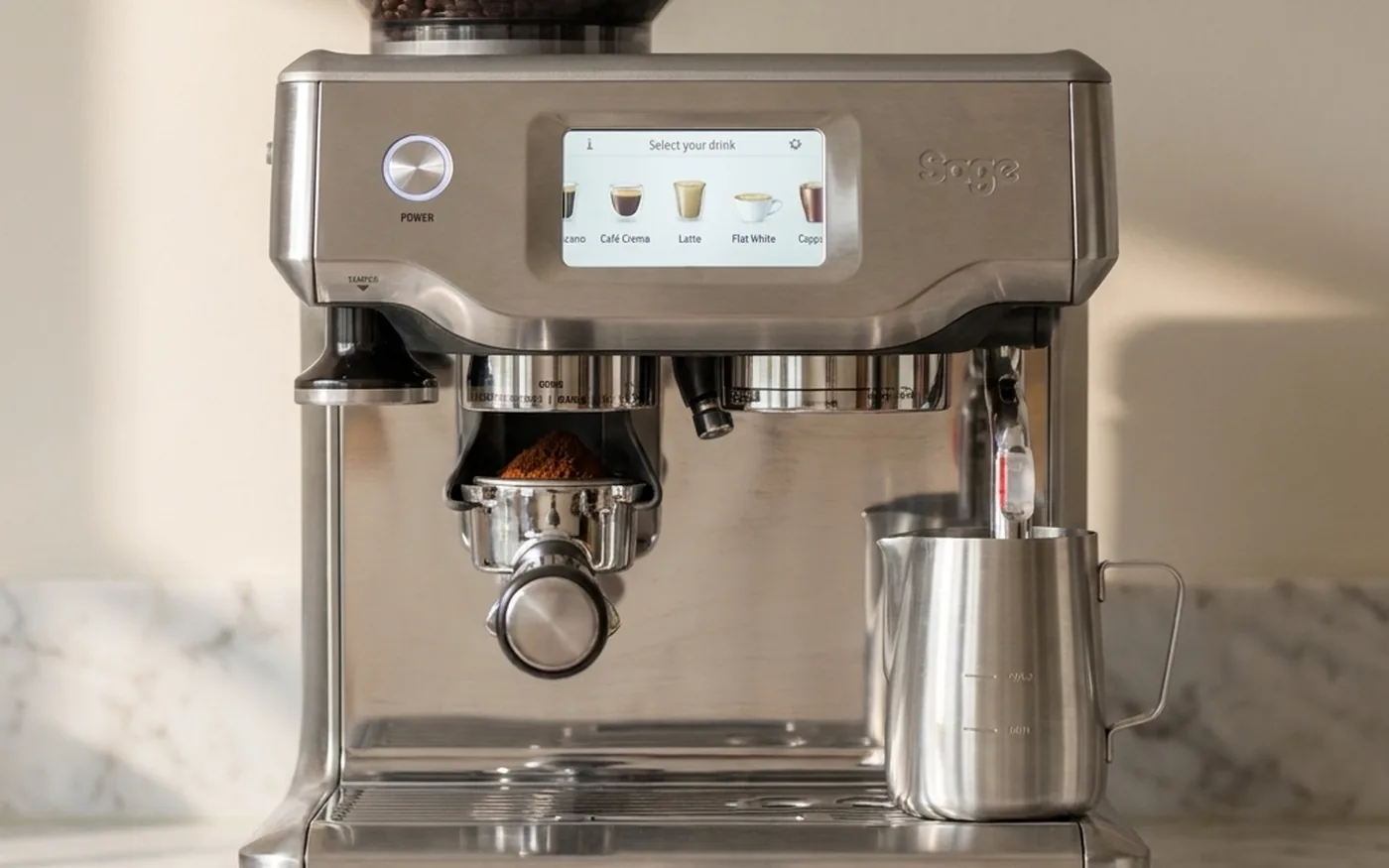
The Sage Barista Touch Impress is a semi-automatic espresso machine with a fully integrated conical burr grinder, a touchscreen control interface, and Sage's Impress Puck System - the combination of grind-by-weight dosing and auto-tamping that defines this machine against its siblings in the range.
The ThermoJet heating system is the key to the fast workflow Sage advertises. It heats from cold to extraction temperature in around three seconds, which means you do not face the warm-up wait that dual-boiler machines require. The trade-off is that the machine uses a single thermoblock rather than a dedicated steam boiler, which affects the milk texturing ceiling and is the main structural difference between this machine and the Oracle Touch above it in the range.
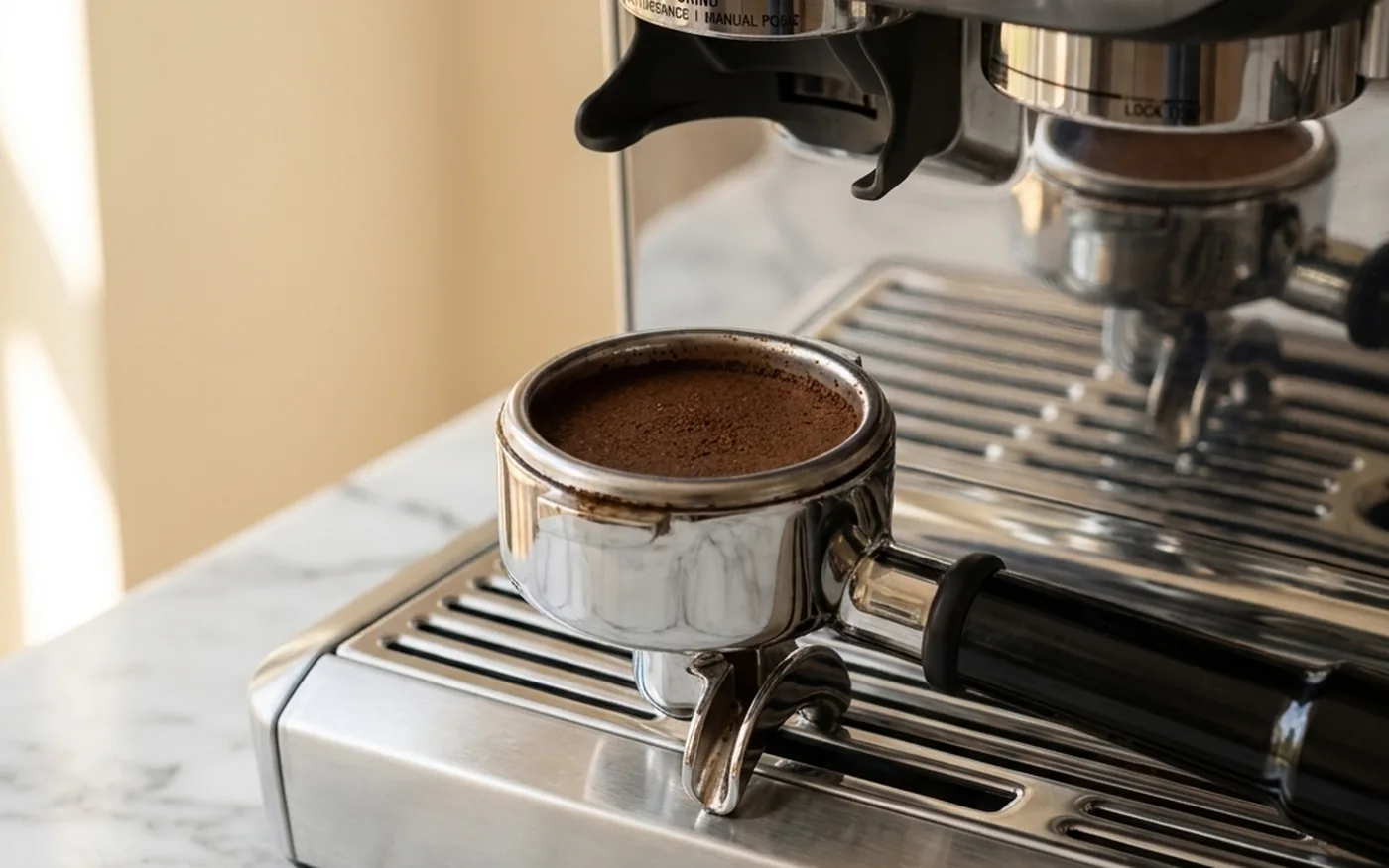
The Impress Puck System is worth understanding before you buy. The grinder doses your shot by weight, not by time or grind amount alone, stopping when the target dose weight is reached. The portafilter then locks into an integrated tamper that applies consistent, calibrated pressure before you pull the shot. What this means in practice is that the two most common sources of shot-to-shot inconsistency in home espresso - incorrect dose weight and uneven tamping - are standardised by the machine rather than left to you.
| Specification | Detail |
|---|---|
| Heating system | ThermoJet (single thermoblock, around 3-second heat-up) |
| Grinder | Integrated 45mm conical burr, grind-by-weight |
| Portafilter | 54mm |
| Pump pressure | 9 bar |
| Puck system | Impress auto-tamping (integrated) |
| Steam | AutoMilk automatic texturing |
| Interface | Touchscreen |
| Water tank | around 2L |
| UK price | £999 (as of May 2026) |
| Official page | sageappliances.com/uk |
How I Tested It
The Barista Touch Impress was evaluated through The Editor Lab, Balance Journal's structured framework for assessing coffee equipment. Evaluation covered extraction consistency across multiple shot types, grind-by-weight accuracy and dose repeatability, AutoMilk performance across cappuccino, flat white, and latte builds, heat-up consistency from a cold start, and build quality under daily-use conditions.
Assessment draws on professional machine evaluation experience built across two phases: five and a half years inside Sanremo UK, where I was trained by engineers on the systems that underpin machines at this and higher price points, and ongoing evaluation of prosumer machines against the extraction standards used by UK specialty roasteries. The Specialty Coffee Association brewing standards serve as the extraction yield benchmark throughout, with 18-22% targeted as the pass threshold for shot quality.
Day-to-Day Use: The Honest Experience
The first thing you notice about daily use on the Barista Touch Impress is how few decisions stand between waking up and drinking. Load your beans, select the shot size on the touchscreen, place the portafilter under the grinder, let the Impress system dose and tamp, then pull. The workflow is closer to a bean-to-cup machine than a traditional semi-automatic, and whether that is a selling point or a drawback depends entirely on why you bought a prosumer machine in the first place.
The grind-by-weight mechanism works reliably. Once you have calibrated your grind setting for your beans, the machine reproduces the same dose within a narrow tolerance across multiple shots. You will still need to adjust grind size when you move to a new bag or when your current bag ages past its peak - the machine handles the weight, but the grind setting is still your variable. This is a genuine workflow improvement over the standard Barista Touch, where dose variation accumulates unless you are weighing manually.
The Impress auto-tamping creates a consistently level puck at consistent pressure every time. The significance of this is easier to appreciate if you have watched home baristas tamp freehand over a few months: the angle drifts, the pressure varies, the extraction goes sideways. The auto-tamp removes that variable from your shot. What it does not do is replace the feedback loop you get from manual tamping, where the feel of resistance tells you something about how your dose and grind are sitting. You lose that tactile information when the machine handles it.
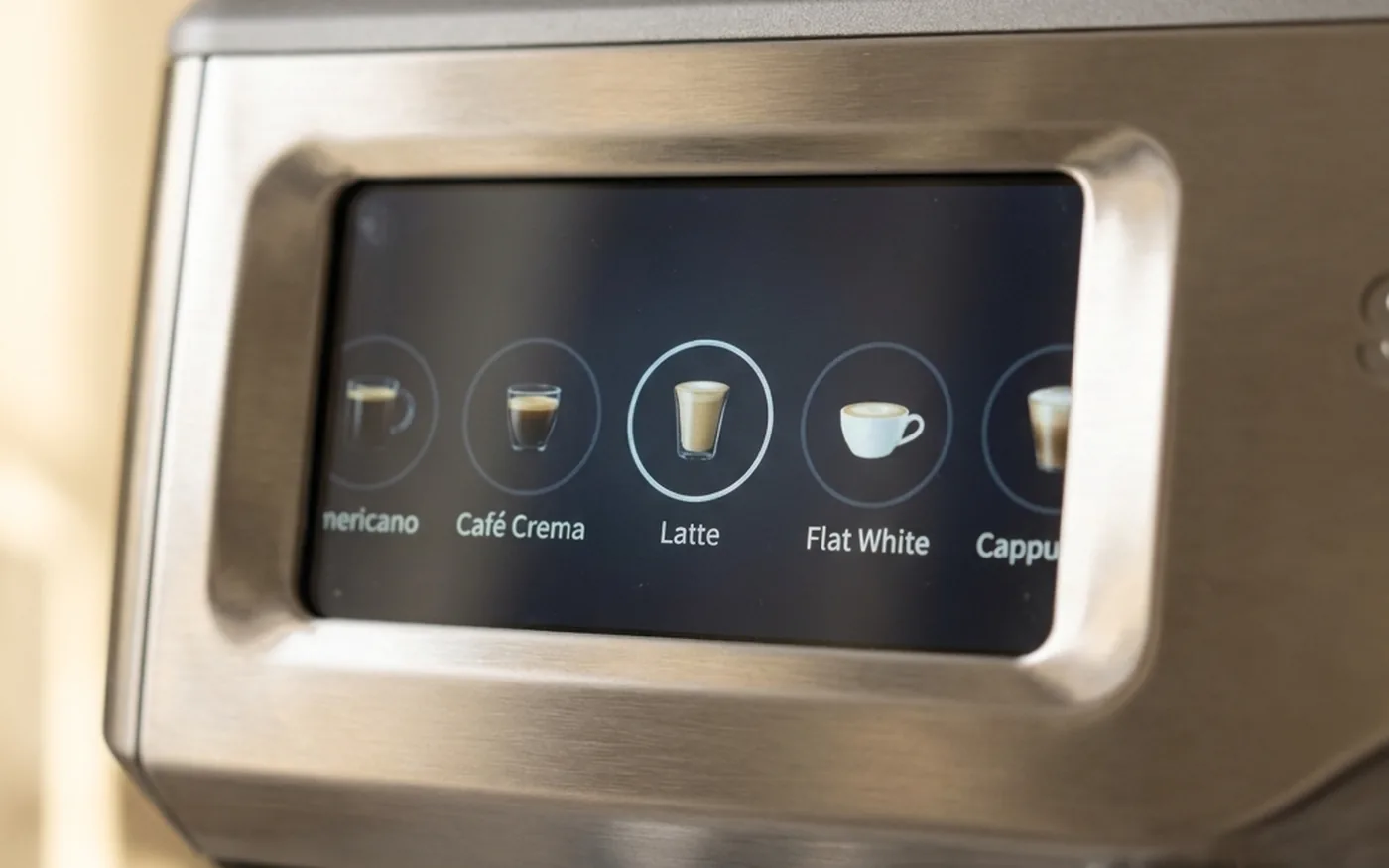
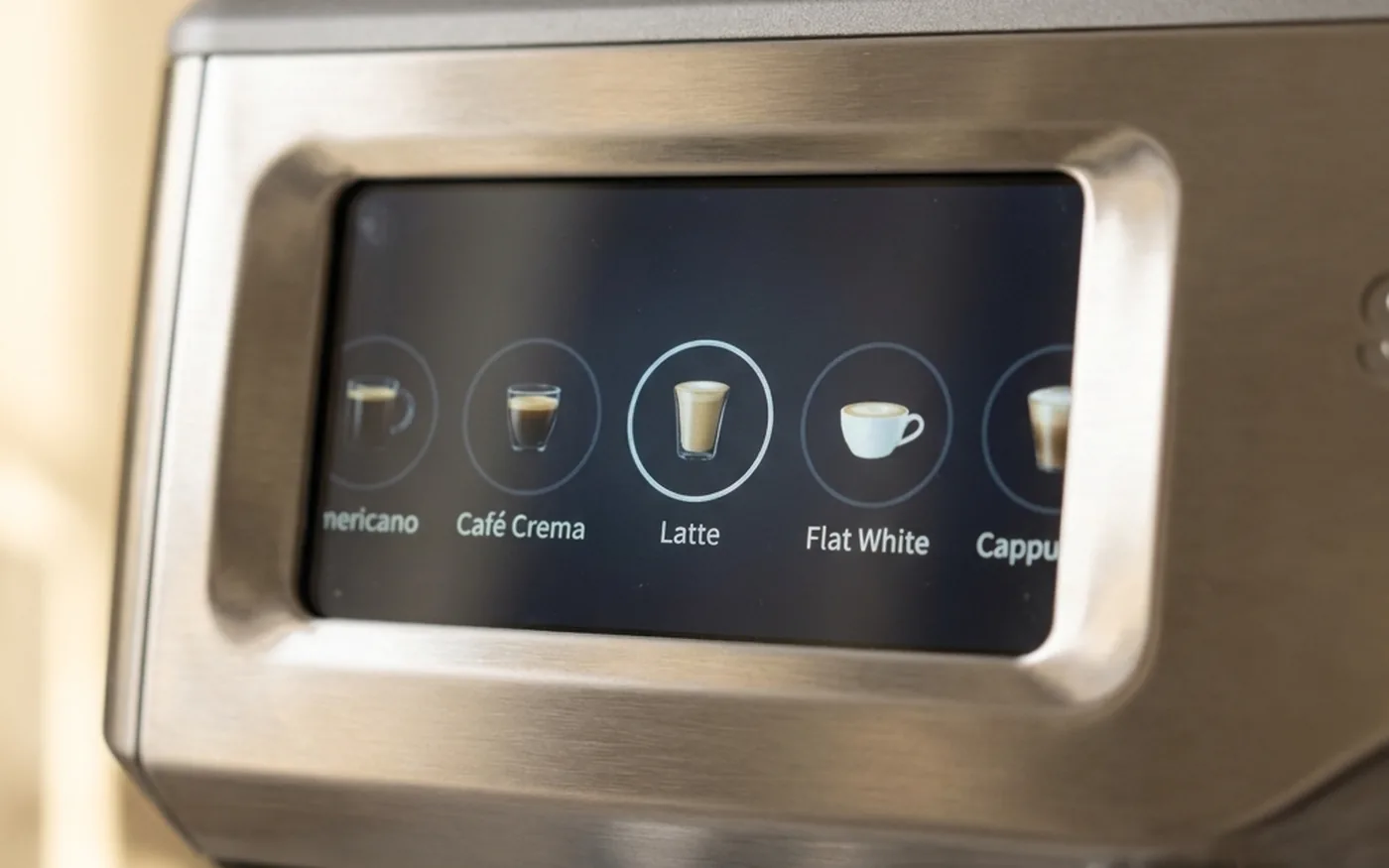
The touchscreen is navigating shot size, drink type, grind setting adjustment, and the cleaning cycle. It is not doing anything the buttons and dials on the Barista Express Impress cannot do - it is doing it through a more convenient interface. If you have used any modern touchscreen appliance, you will not need the manual to get started on the Barista Touch Impress.
Heat-up from cold is genuinely fast with the ThermoJet system. You are not waiting the 20-30 minutes that a commercial dual-boiler demands before temperature stabilises. The machine reaches extraction temperature in seconds, which means it fits into a morning routine without needing to be switched on in advance.
Espresso Quality
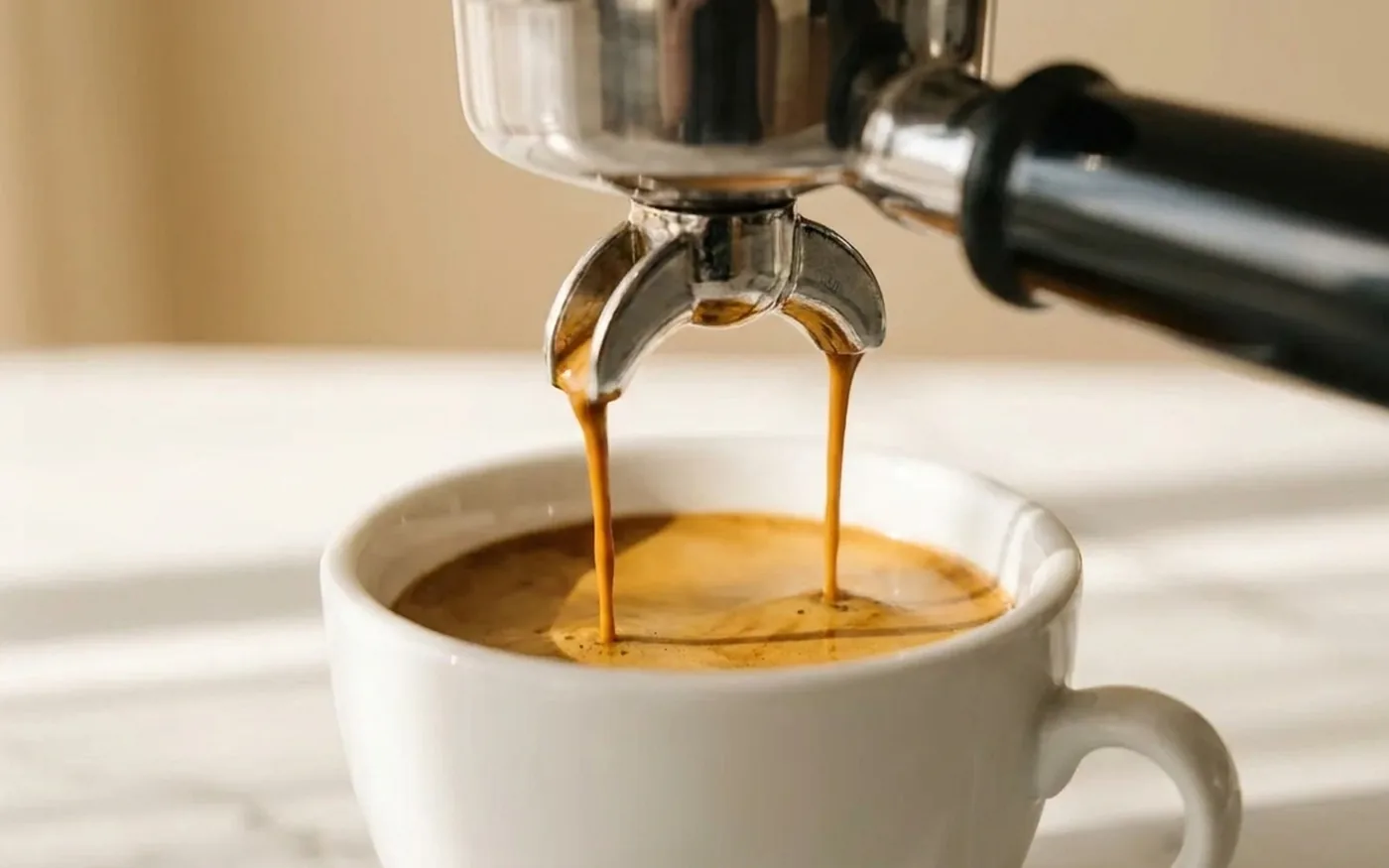
The Barista Touch Impress extracts a consistent and competent espresso across a range of roast styles. On a light-to-medium washed Colombian, the output was clean on the nose with a balanced fig sweetness through the mid-palate and a finish that held without tipping into bitterness. On a darker natural Ethiopian, the body rounded out with a deeper, rounded sweetness and the finish carried a mild fruit brightness. Across multiple shots at the same grind setting, the shot-to-shot consistency was notably tighter than you would achieve on the same machine without grind-by-weight.
The Specialty Coffee Association targets an extraction yield of 18-22% for espresso - the range where sweetness, acidity, and bitterness balance in the cup. Once you have dialled your grind setting for your specific beans, the Barista Touch Impress sits reliably in this window, with the Impress system managing dose and tamp. That is the machine doing exactly what it was designed to do.
What the spec sheet does not tell you is where the extraction ceiling sits. The integrated 45mm conical burr grinder is capable and quiet enough for home use, but it is not in the same category as a standalone grinder at the same price point. If you are using specialty-grade single-origin beans and want to push extraction accuracy to competition-level precision, the grinder becomes the limiting factor before anything else does. You are buying a consistency system here, not a precision extraction platform.
For most buyers this distinction is academic. If your daily output is double espressos, flat whites, and the occasional cappuccino, the extraction quality here is more than sufficient. If you are chasing a specific flavour profile from a high-end natural and want a grinder that lets you pursue it precisely, a Barista Pro paired with a standalone grinder is the more capable route.
Auto-Steam and Milk Texturing
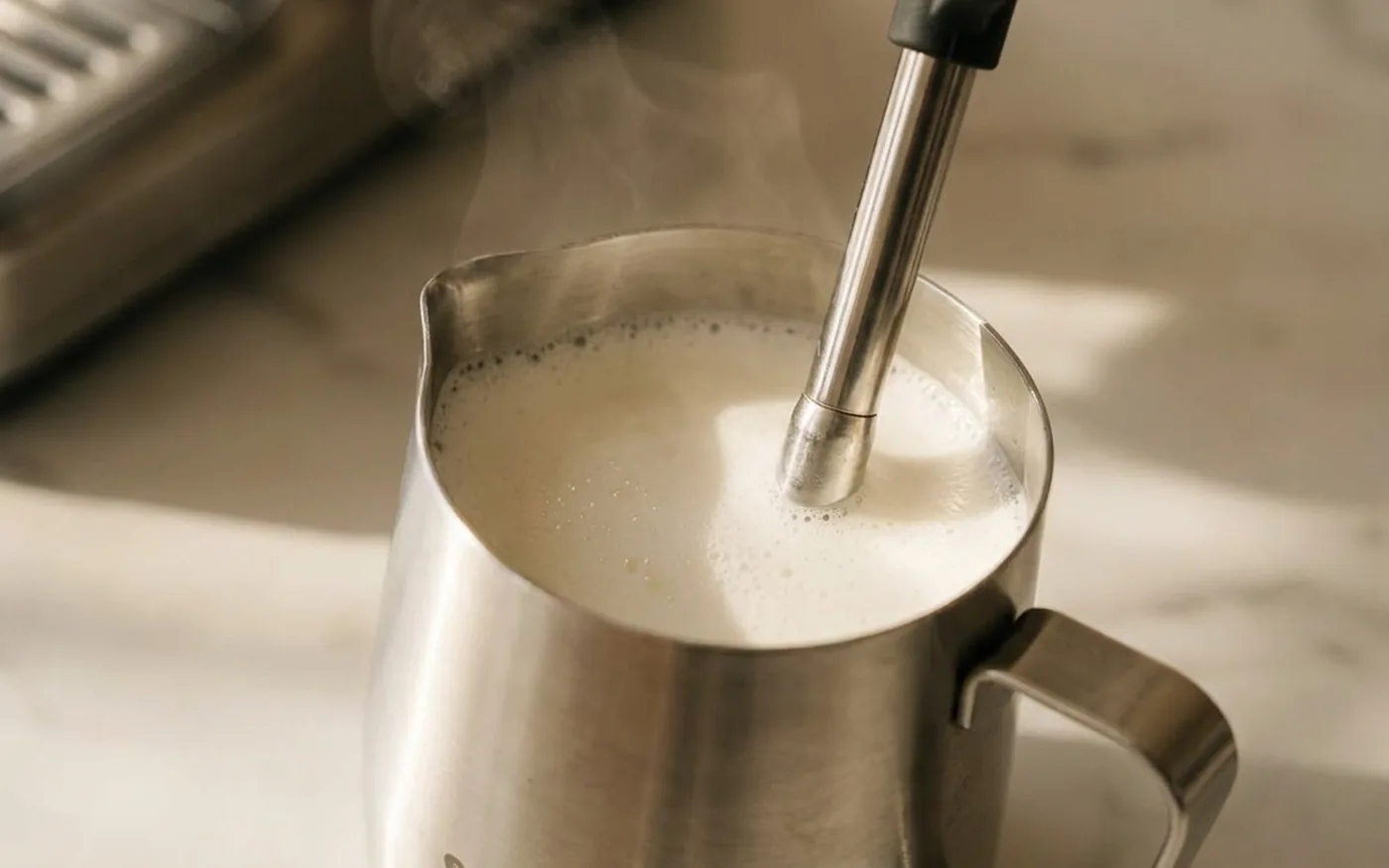
The AutoMilk system handles automatic milk texturing at a temperature and texture you set through the touchscreen. For flat whites and cappuccinos, the output is consistent: microfoam with a fine, integrated texture at a repeatable temperature, every time you press go. The machine manages the steam from start to purge without any manual input from you.
Where AutoMilk has a ceiling is latte art. The automatic texturing produces milk that is well suited to consistent, repeatable pours, but it does not give you the manual control over foam density and pour speed that freeform latte art requires. If you are pulling a rosette or a tulip every morning, this is the wrong machine. If you want a consistently textured flat white without picking up a steam wand technique, it is exactly the right one.
The comparison to manual steaming is worth stating directly. Having worked on commercial machines most home baristas will never touch, there is a real and noticeable step up in capability at that level. The Barista Touch Impress is not trying to compete with those machines and it does not need to. For someone producing milk drinks at home without wanting to invest time in wand technique, the AutoMilk system delivers a result that most consumers will find difficult to fault.
Temperature consistency on the milk side is reliable within the ThermoJet's constraints. The single thermoblock manages both brew temperature and steam, which means you are pulling your shot and steaming your milk sequentially rather than simultaneously. For a single-cup workflow, this is not a meaningful constraint. If you are regularly making drinks for two or more people in quick succession, factor in the reset time between steam and brew.
Sage Barista Touch Impress vs Barista Touch: Which Should You Buy?
The difference between the Barista Touch and the Barista Touch Impress comes down to two components: grind-by-weight dosing and the Impress auto-tamping system. Everything else - the touchscreen interface, the AutoMilk steam system, and the ThermoJet heating - is identical across both machines. You are paying approximately £170 for those two additions.
The case for the standard Barista Touch is that if you are already weighing your doses manually and tamping with a calibrated tamper at consistent pressure, the Impress system does not significantly improve on what you are already doing. The case for the Touch Impress is that most home baristas are not doing either of those things, and the inconsistency in their shots traces directly back to those two variables.
| Feature | Barista Touch | Barista Touch Impress |
|---|---|---|
| Price (May 2026) | £829 | £999 |
| Grind by Weight | No | Yes |
| Auto-tamping | No | Yes (Impress system) |
| AutoMilk steam | Yes | Yes |
| Touchscreen | Yes | Yes |
| Heating | ThermoJet | ThermoJet |
Buy the Touch Impress if consistency matters more to you than manual technique engagement. Buy the standard Touch if you already have strong manual practice and prefer to keep those variables in your hands. The Sage Barista Touch review covers the standard model in detail.
Sage Barista Touch Impress vs Barista Express Impress
The Touch Impress and the Sage Barista Express Impress share the same core innovation: the Impress Puck System, with grind-by-weight dosing and auto-tamping on every shot. The price gap between them is approximately £200. The two defining differences are the interface and the steam system.
The Barista Express Impress uses a manual steam wand and a traditional button and dial interface. The Barista Touch Impress replaces those with a touchscreen and the AutoMilk automatic texturing system. If you are primarily interested in the Impress puck system, the Express Impress delivers the same dose-and-tamp consistency at a lower price.
| Feature | Barista Express Impress | Barista Touch Impress |
|---|---|---|
| Price (May 2026) | £799 | £999 |
| Grind by Weight | Yes | Yes |
| Impress auto-tamping | Yes | Yes |
| Steam | Manual wand | AutoMilk (automatic) |
| Interface | Buttons and dials | Touchscreen |
| Heating | ThermoJet | ThermoJet |
The question you are answering with the £200 upgrade is whether AutoMilk and the touchscreen justify the premium. On the AutoMilk question: if you drink predominantly milk-based espresso drinks and want consistent results without developing a manual steam technique, yes. If you want to build wand technique or need the ceiling for latte art, no - the Express Impress manual wand gives you that control. On the touchscreen question: it is a convenience upgrade, not a quality one. You are not extracting better coffee through it.
The straightforward recommendation: choose the Express Impress if you want the Impress system and a manual steam wand. Choose the Touch Impress if you want the Impress system and the convenience of automatic milk texturing.
Who It Is For (and Who Should Look Elsewhere)
The Barista Touch Impress suits you if you want the most consistent home espresso the Sage semi-automatic range can produce without going fully automatic. You are not looking for a manual workflow. You are not primarily interested in building barista technique for its own sake. You want a reliably good shot and a consistently textured flat white, and you want the machine to handle the variables that most often create inconsistency in home espresso.
You should look elsewhere if:
You want full manual control. The Sage Barista Pro gives you a semi-automatic machine with a manual steam wand and no automated puck system - you retain all the variables and all the feedback. It costs less.
You want fully automatic. The Sage Oracle Touch handles grinding, dosing, tamping, and milk texturing in a more capable dual-boiler package. The jump from the Touch Impress to the Oracle Touch is approximately £450 at current pricing.
You are newer to espresso and price-sensitive. At £999, you are committing significantly before knowing whether home espresso will become a daily habit. Reviewing options in the best espresso machine for beginners range first is the more considered approach before stepping up to this price.
You want a machine you can grow into technically. The automated puck system is a convenience ceiling, not a skills ceiling. If developing manual technique matters to you over time, a machine that keeps those variables in your hands will serve you better long-term.
What to Brew With It
The Barista Touch Impress extracts best with espresso-roasted whole beans, ground fresh through the integrated burr grinder. The grind-by-weight system is calibrated for espresso dose weights, and the 9-bar extraction pressure suits medium to dark roasts that hold body and sweetness under those conditions.
For espresso-suited roasts, look for beans described as medium to medium-light with balanced flavour notes that work well under pressure extraction. A light roast with high fruit acidity can work on this machine, but you will need to adjust grind finer and may find the extraction less forgiving than a blend designed for the espresso dose range. The Balance Coffee Rotate Espresso, a Mexico single-origin at light-to-medium roast, performs well in this machine's extraction profile. Balance Coffee is the parent brand of Balance Journal - I have included it here because it genuinely suits this machine, not because of any commercial arrangement.
You can find the full breakdown of espresso-suited roasts in our guide to the best coffee beans for espresso.
Final Verdict and Score
The Sage Barista Touch Impress does exactly what it is designed to do. It removes the variables that create inconsistency in home espresso and delivers a repeatable, quality result without demanding barista-level technique from you. The Impress Puck System is a genuine quality-of-life upgrade for anyone who has spent time chasing shot consistency and found the source of variance in their dosing and tamping. The AutoMilk system handles milk drinks consistently for the large majority of home use cases.
The honest caveat at £999 is that you are paying primarily for automation, not for a higher extraction ceiling. The grinder is capable but not exceptional. The ThermoJet is fast but single-channel. If you want to grow technically as a home barista over time, the Barista Pro at a lower price with a manual steam wand is the better long-term investment for that profile. The Touch Impress optimises for consistency and convenience, and it delivers both.
For the buyer who wants a consistent machine that reduces the daily skill requirement without going fully automatic, the Touch Impress at £999 is a justified purchase.
Final Score: 8.0 / 10
| Dimension | Score |
|---|---|
| Espresso Quality | 8/10 |
| Milk Texturing | 8/10 |
| Build Quality | 8/10 |
| Ease of Use | 9/10 |
| Value at Price | 7/10 |
| Grinder Performance | 7/10 |
| Overall | 8.0/10 |
Frequently Asked Questions
Is the Sage Barista Touch Impress worth the money?
At £999, the Barista Touch Impress is worth it if consistent home espresso is your primary goal and you do not want to invest time developing manual dosing and tamping technique. The Impress Puck System removes the two most common sources of shot-to-shot variation in home espresso. If you are prepared to learn manual dialling and tamping, the Barista Pro at a lower price point gives you more control for less money.
What is the difference between the Sage Barista Touch and the Barista Touch Impress?
The Barista Touch Impress adds grind-by-weight dosing and the Impress auto-tamping system that the standard Barista Touch lacks. The touchscreen interface, AutoMilk steam system, and ThermoJet heating are identical across both machines. The price premium is approximately £170 for those two additions alone.
How does the Impress Puck System work?
The Impress Puck System is a two-stage mechanism integrated into the grinder and portafilter. The grinder first doses your shot by weight, stopping when the target dose is reached rather than running on a timer. The portafilter then locks into an integrated tamper that applies consistent, calibrated pressure to the puck before extraction begins. Both stages happen automatically before you pull the shot.
What grinder does the Barista Touch Impress use?
The Barista Touch Impress uses an integrated 45mm conical burr grinder with grind-by-weight technology. The grinder is built into the machine body and is not separable as a standalone unit. It is capable for daily home use across most roast styles at espresso grind settings, though it is not in the same category as a dedicated standalone grinder at a comparable price.
Is the Barista Touch Impress good for beginners?
The Barista Touch Impress is better described as a machine for home espresso drinkers who want consistent results without extensive technique development. On pure price, it is not the most appropriate starting point: at £999, you are committing significantly before knowing whether home espresso suits your daily habits. If you are new to espresso, reviewing options in the £400-600 price range before stepping up to this level is the more considered approach.
How does the Barista Touch Impress compare to the Barista Express Impress?
Both machines share the same Impress Puck System, so the grind-by-weight dosing and auto-tamping are identical. The Touch Impress adds a touchscreen interface and the AutoMilk automatic steam system in place of the Express Impress manual steam wand and traditional controls. If you want the Impress puck system with manual steam control, the Express Impress delivers that at approximately £200 less.
How good is the steam wand on the Barista Touch Impress?
The AutoMilk system produces consistent microfoam for flat whites, cappuccinos, and lattes without any manual technique required. The ceiling is latte art: automatic texturing removes the control over foam density and pour speed that freeform designs need. If consistent, well-textured milk drinks are the goal, the AutoMilk delivers reliably. If learning to pour latte art matters, a machine with a manual wand is the better fit.
How many grind settings does the Barista Touch Impress have?
The Barista Touch Impress offers 30 grind size settings on its integrated 45mm conical burr grinder. Settings are adjusted through the grind dial on the machine body. The range spans espresso through to coarser grind profiles, though in practice this machine is optimised for espresso dosing. You will typically work within a narrow band of settings once dialled in for your specific beans.
How large is the water tank and how often does it need refilling?
The Barista Touch Impress has a water tank of around 2 litres, which sits at the rear of the machine and is removable for filling. For a single person making two to three espresso-based drinks per day, the tank typically lasts two to three days before needing a refill. The machine also requires a monthly descale cycle, and Sage includes a water filter to reduce mineral buildup.
A wellness entrepreneur and biohacker, James explores the intersection of hospitality and health - from clean fuel and recovery tools to mindful routines that build balance into daily life.